
Computer User Corner: Melatonin and Screens
Computing devices of all sizes - from a desktop computer to smart watches - over the past decade have penetrated the lives of most people. Many start a new day by reading news feeds and social networking and end it the same way. And if in the morning and afternoon hours this behavior is harmless to the body, then in the hours before bedtime it will not only worsen it, but, in the long run, health.
Many physiological processes in living organisms follow a 24-hour cycle. These cycles are called circadian (from the Latin "circa dies", which means "around the day"). Circadian rhythms affect the sleep and wake cycle, hormone levels, body temperature, heartbeat, digestion and other functions. Circadian rhythms are consistent with the "biological clock" - an accumulation of cells in the hypothalamus ("hypo" - under, "thalamus" - the thalamus, the name of the brain department), called the suprachiasmatic nucleus ("supra" - above, "chiasma" - the name of the optic nerve cross) .
The primary reference point for a “biological clock” is light. In addition to cones and rods, there is a third type of cell on the retina of the eye: melanopsin-containing ganglion cells. They transmit through the nerve channel, called the retino-hypothalamic pathway (“retina” - the retina), information about the illumination of the environment into the suprachiasmatic nucleus. This process is not associated with vision and therefore works for some blind people . When it gets dark, the core, in turn, sends a signal to the pineal gland (pineal gland) to produce the hormone melatonin, which is formed from the neurotransmitter serotonin (hence the name formed by the combination of the words “melas” - black + serotonin). An increase in melatonin leads to sleep. During the day, the release of melatonin is suppressed by light entering the retina, which leads to increased alertness and attention.
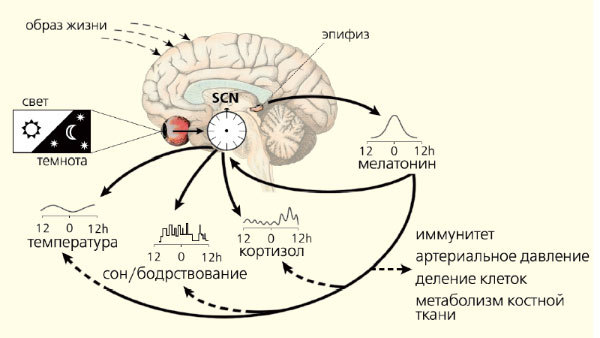
There is abundant scientific evidence that circadian rhythm disturbances are associated with increased mortality, cancer, diabetes, cardiovascular disease, obesity, gastrointestinal disorders, immunity disorders, mental disorders, depression, memory impairment, and learning deficits. The most malicious “violators” of circadian rhythms are working in night, early morning shifts and on a flexible schedule, and frequent flights between time zones. The WHO International Agency for Research on Cancer concluded in 2007 on the basis of experimental studies that “a decrease in nighttime melatonin levels increases the incidence or growth of tumors ”, and classifies shift work leading to circadian rhythm disturbances as probable carcinogens (i.e., to group 2A).
However, different colors of the light spectrum affect the production of melatonin and, as a consequence, circadian rhythms, in different ways. Most of all, the production is suppressed by blue light, with a wavelength of about 450 nm. The spectrum of all light sources used until recently by people - from bonfires to incandescent lamps - is shifted toward red, so there was no problem of circadian rhythm disturbances. The latest light sources, such as fluorescent and diode lamps for the most part, as well as screens of all types emit mainly blue light .
A 2014 scientific study found that using tablet computers before bedtime
All this is true to varying degrees in relation to all devices with screens, with the exception of devices based on electronic ink (e-books) when used without backlight.
The f.lux application automatically changes the hue of the device screens with the setting of the Sun depending on the location and cuts off the blue spectrum of radiation, restoring the hue with sunrise. The change is smooth and barely noticeable. Also, users can configure the program mode for a certain time.
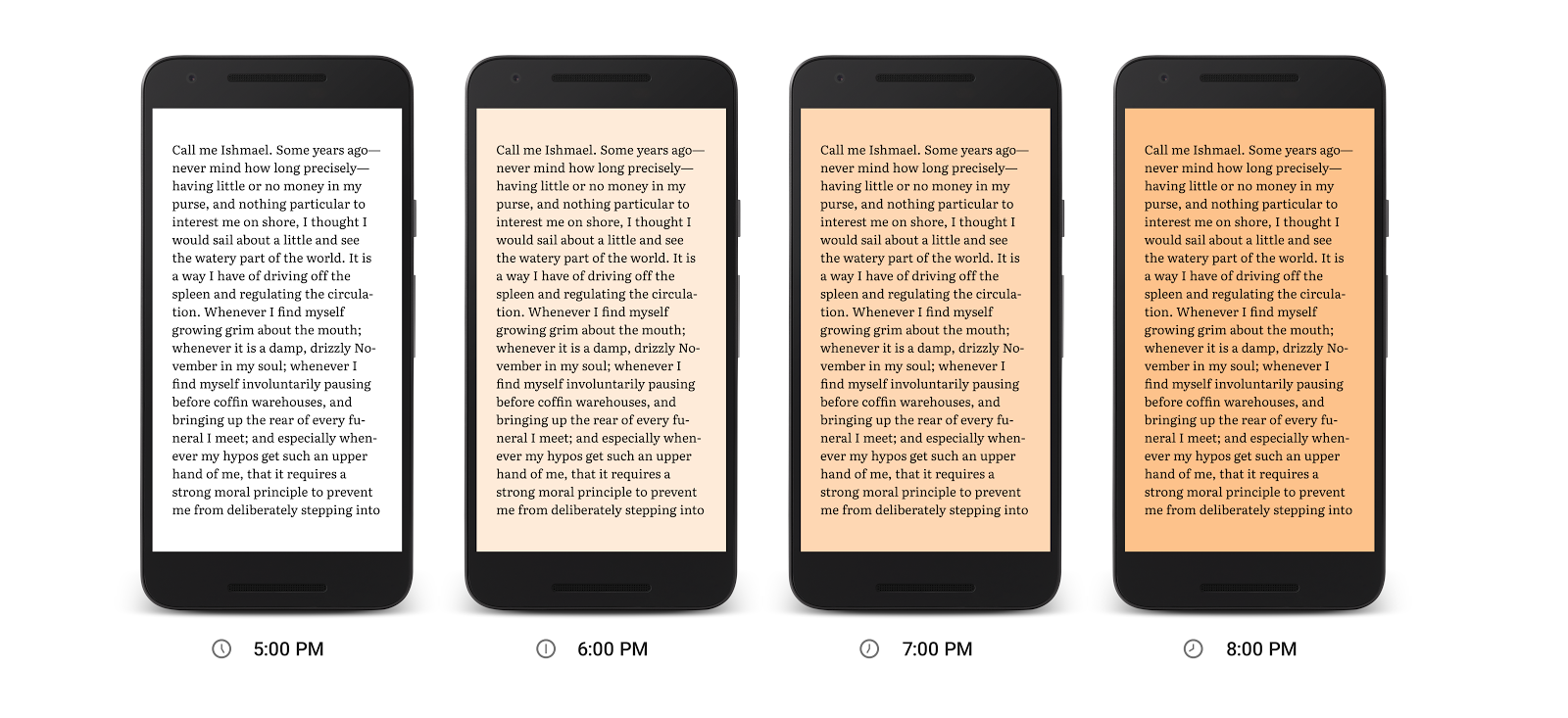
f.lux works on Linux, Windows, OS X, Android, and iOS. To install f.lux on wearable devices, their operating systems need to be hacked. In the case of Android, you need to get root access to the system. According to the developersf.lux, existing Android apps do not work as efficiently as root access is required. Therefore, another option for Android users is to install CyanogenMod , which includes the LiveDisplay function, the operation of which is similar to f.lux.
In the case of iOS, you need to make a jailbreak. Another option for iOS users who have access to OS X is to deploy (side-load) f.lux (or its GoodNight equivalent) using Xcode. 7 years after the release of the first version of f.lux, Apple will add the “Night Shift” function, which performs the same role as f.lux, in the upcoming iOS update, 9.3. However, it will be available only for devices with 64-bit architecture, that is, those currently manufactured, and will be turned off in power saving mode.
For more information on melatonin and the health effects of its production, see Vladimir Anisov’s article, “ Life Chronometer, ” from the journal Nature .
See also:
Computer user corner: privacy of correspondence
Computer user corner: civic activism
Many physiological processes in living organisms follow a 24-hour cycle. These cycles are called circadian (from the Latin "circa dies", which means "around the day"). Circadian rhythms affect the sleep and wake cycle, hormone levels, body temperature, heartbeat, digestion and other functions. Circadian rhythms are consistent with the "biological clock" - an accumulation of cells in the hypothalamus ("hypo" - under, "thalamus" - the thalamus, the name of the brain department), called the suprachiasmatic nucleus ("supra" - above, "chiasma" - the name of the optic nerve cross) .
The primary reference point for a “biological clock” is light. In addition to cones and rods, there is a third type of cell on the retina of the eye: melanopsin-containing ganglion cells. They transmit through the nerve channel, called the retino-hypothalamic pathway (“retina” - the retina), information about the illumination of the environment into the suprachiasmatic nucleus. This process is not associated with vision and therefore works for some blind people . When it gets dark, the core, in turn, sends a signal to the pineal gland (pineal gland) to produce the hormone melatonin, which is formed from the neurotransmitter serotonin (hence the name formed by the combination of the words “melas” - black + serotonin). An increase in melatonin leads to sleep. During the day, the release of melatonin is suppressed by light entering the retina, which leads to increased alertness and attention.
There is abundant scientific evidence that circadian rhythm disturbances are associated with increased mortality, cancer, diabetes, cardiovascular disease, obesity, gastrointestinal disorders, immunity disorders, mental disorders, depression, memory impairment, and learning deficits. The most malicious “violators” of circadian rhythms are working in night, early morning shifts and on a flexible schedule, and frequent flights between time zones. The WHO International Agency for Research on Cancer concluded in 2007 on the basis of experimental studies that “a decrease in nighttime melatonin levels increases the incidence or growth of tumors ”, and classifies shift work leading to circadian rhythm disturbances as probable carcinogens (i.e., to group 2A).
However, different colors of the light spectrum affect the production of melatonin and, as a consequence, circadian rhythms, in different ways. Most of all, the production is suppressed by blue light, with a wavelength of about 450 nm. The spectrum of all light sources used until recently by people - from bonfires to incandescent lamps - is shifted toward red, so there was no problem of circadian rhythm disturbances. The latest light sources, such as fluorescent and diode lamps for the most part, as well as screens of all types emit mainly blue light .
A 2014 scientific study found that using tablet computers before bedtime
- reduces melatonin production by 55%,
- increases the time required to fall asleep by 10 minutes,
- reduces the quality of sleep due to the shortening of the phase of rapid eye movement by 10%,
- in the morning it shifts the time for the onset of alertness by several hours (otherwise it comes almost immediately),
- shifts the daily rhythm by 90 minutes.
All this is true to varying degrees in relation to all devices with screens, with the exception of devices based on electronic ink (e-books) when used without backlight.
The f.lux application automatically changes the hue of the device screens with the setting of the Sun depending on the location and cuts off the blue spectrum of radiation, restoring the hue with sunrise. The change is smooth and barely noticeable. Also, users can configure the program mode for a certain time.
f.lux works on Linux, Windows, OS X, Android, and iOS. To install f.lux on wearable devices, their operating systems need to be hacked. In the case of Android, you need to get root access to the system. According to the developersf.lux, existing Android apps do not work as efficiently as root access is required. Therefore, another option for Android users is to install CyanogenMod , which includes the LiveDisplay function, the operation of which is similar to f.lux.
In the case of iOS, you need to make a jailbreak. Another option for iOS users who have access to OS X is to deploy (side-load) f.lux (or its GoodNight equivalent) using Xcode. 7 years after the release of the first version of f.lux, Apple will add the “Night Shift” function, which performs the same role as f.lux, in the upcoming iOS update, 9.3. However, it will be available only for devices with 64-bit architecture, that is, those currently manufactured, and will be turned off in power saving mode.
For more information on melatonin and the health effects of its production, see Vladimir Anisov’s article, “ Life Chronometer, ” from the journal Nature .
See also:
Computer user corner: privacy of correspondence
Computer user corner: civic activism