
 August 25, 2017 at 11:11
Games for programmers, part two
Four and a half years have passed since I, using a freshly received invite , wrote the previous hub post with a similar headline. Great time for the gaming industry. A lot of new good games have appeared, and recently I felt an urgent need to share knowledge about them with the general public.
Despite the danger that a dispute would arise again regarding the name, I decided to leave it the same in order to maintain continuity. You can perceive it as "games for those who have the ability to program", or something else in this spirit. However, I believe that you are not reading this post for the sake of reasoning about semantics, so let's move on to the point.
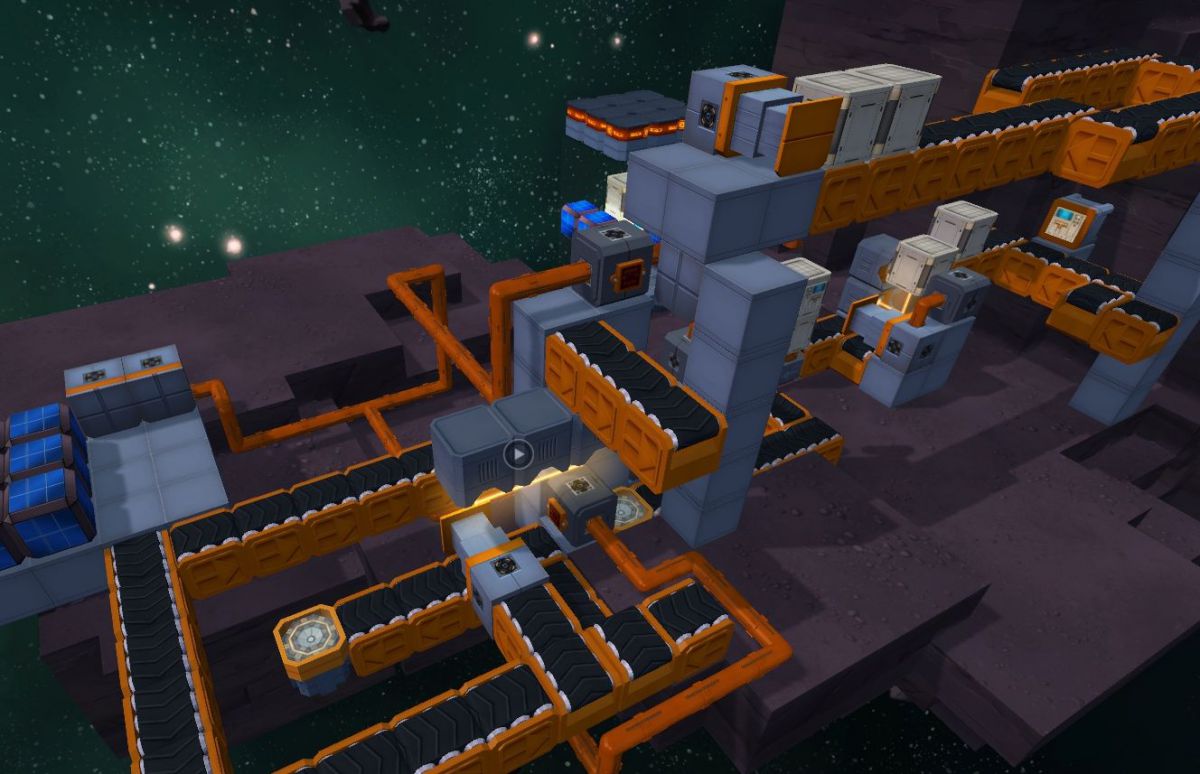
Another game from the author of the magnificent SpaceChem, with a review of which my previous post began. Now (fanfare and squeals of schoolgirls) - in 3D! In principle, the presence of the third dimension is the most significant difference from the previous game. The essence of the gameplay has not undergone any special changes: you need to take parts from the entrance, make other parts from them and send them to the exit. However, it cannot be said that Infinifactory is purely secondary. The presence of gravity, methods of manipulating parts - all this creates completely new tasks without causing a sense of deja vu.
The plot delivers particular pleasure. Yes, yes, the plot of the puzzle about creating conveyors. Almost a production drama ... in space. The main character was abducted by powerful, but rather stupid aliens, and now he works for them for food. The plot influences how exactly the sets of cubes at the entrances and exits of the conveyor are called and look. I think you will never be able to erase from memory a mission about the manufacture of canned whale. You can also recall the wonderful cynicism with which the game forces you to build an assembly of single cameras, completely similar to the one in which you are between missions. However, why am I writing this? You probably already quit reading and went to install the game.
By the way, an interesting fact: the resemblance to Minecraft is not accidental. The creator of Infinifactory is also the author of the old little-known game Infiniminer, one of the ideological clones of which was once Minecraft.
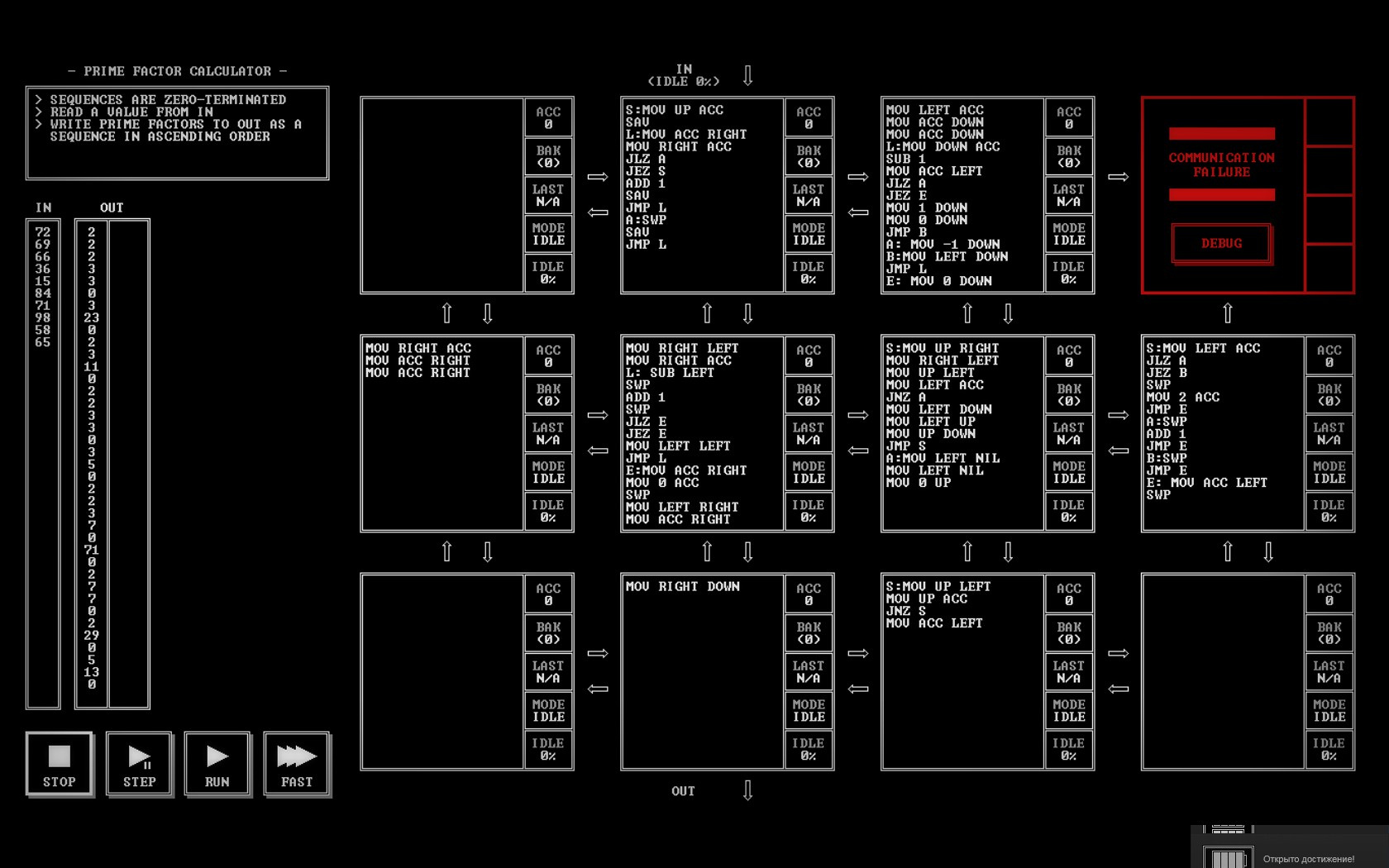
A game of the same developer, about which there is already a separate article on Habré , but I still will write about it in my own words, because I like to write, and the game deserves it. In short, this is a simulator of a primitive multi-threaded assembler, on which you have to write a variety of Hello Worlds on the plot. Its capabilities are poor, and each node contains a very limited number of lines, which is why the programmer has difficulties that (I hope) are unlikely to be encountered in real work. And so that life does not seem honey, nodes communicate with each other asynchronously. Out of these difficulties, the essence of the game is born: not a single node can fully implement a somewhat complicated algorithm, so you have to share it between the nodes, sometimes in a cruel and unnatural way.
Yes, and there is also a plot. The plot of the game is about multi-threaded assembler. It sounds even funnier than the old Tetris: Story Mode joke. Its essence is that the main character remains a legacy vintage-looking device with a very strange architecture. By programming it, the hero restores the data from the broken nodes and gradually finds out its history - where it came from, why it was created. And I must say, this is not that knowledge, acquaintance with which passes without a trace ...

And here is another assembler. Deceptively simple, with cartoony graphics and "mouse programming." Probably not one child, having received a “children's developmental” game as a present, furiously broke his keyboard knee-deep, trying to optimize the solution of some moronic simple task, so that it would be performed two measures faster.
In fact, if the child is not a perfectionist, aimed at one hundred percent passage, then this will really be a good educational game for him. And, and if you are suddenly interested, the creators of the Human Resource Machine are those who made World of Goo.
By the way, since we are talking about educational games ...

After such low-level things like assembler, why not ... go down one level? MHRD is a game about logical elements in which a player, with his own, one might say, hands, collects a full-fledged processor from bare NANDs. Moreover, the game brings him to this smoothly, without sharp jumps in complexity. In my opinion, the passage of this game should be given as laboratory work to courses such as "Computer Architecture".
The "plot" of the game is straightforward, as in the good old German cinema : the player is hired by MicroHard Corporation, which wants to conquer the processor market, or something like that. Accordingly, while it will conquer the market, the player must assemble the processor itself. This is done using a kind of "programming language", which describes the elements and their relationships. Once the assembled element can be reused in further schemes, without describing it again each time.
Unfortunately, the game did not have quite a bit to become a true diamond. "IDE" slows down, there is no way to play interactively with the collected elements. The game is not great, but very good.
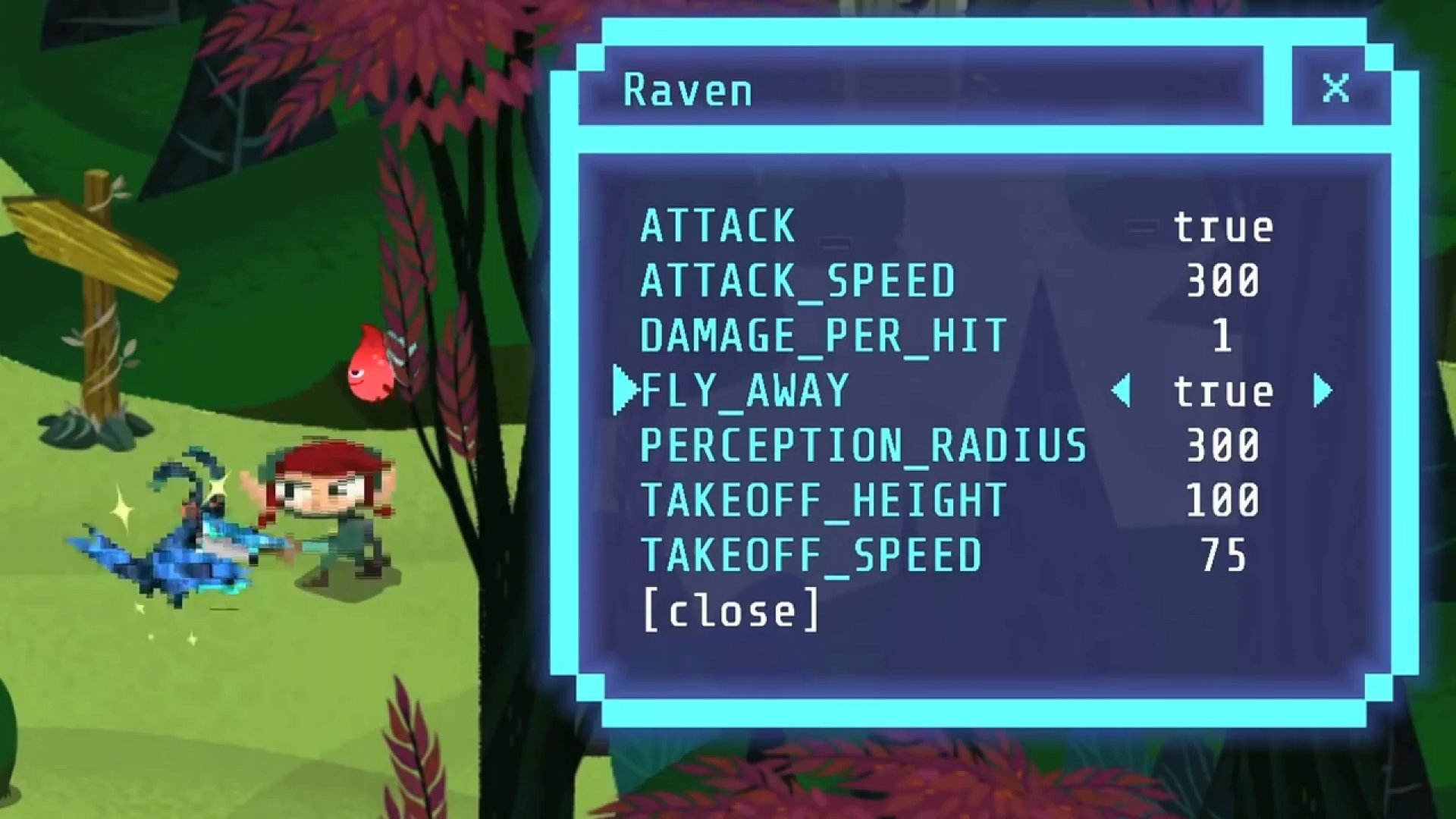
Sometimes players hack games in order to simplify their passage. But what about a game in which hacks are needed to complete? Hack'n'Slash begins with the main character (whose resemblance to the Link from Legend of Zelda, of course, is completely random) finds a strange sword ending in a USB plug. Poking this sword into various game objects, he can change their properties - for example, the most banal, set the property “health” of the monster to “0”.
In the future, the hero finds new artifacts that do other useful things - for example, showing collision boxes of all objects on the screen. And to defeat the final boss, you need to modify the scripts of the game itself, written, incidentally, in the Lua language. Honestly, the graphics freeze me a little, but from a gameplay point of view, the game is very interesting.
And since we started talking about the schedule ...

Since we are talking about the schedule, then Hack'n'Slash has a twin brother who is more pleasant to me for three reasons. Firstly, it is free and open source. Secondly, it is in the ASCII chart, which warms my heart as a person who passed the original Dungeon Crawl. And thirdly, under his hood JS, and not Lua - here, of course, it’s a matter of habit, but the first is already more dear to me than Russian, and the second I only dealt with when writing small mods for Don't Starve.
The gameplay is similar to what happens at the very end of Hack'n'Slash: the player gets access to the game code itself and can modify its individual sections, which is necessary for passing. The game is witty and beautiful; her only flaw is that she is too short.
Well, perhaps that's all. See you in the third part, after another four and a half years.
PS I foresee that the comments mentioned Shenzen IO. I know about its existence, but, unfortunately, I did not have time to play it yet, and therefore did not write about what I really do not know.
Despite the danger that a dispute would arise again regarding the name, I decided to leave it the same in order to maintain continuity. You can perceive it as "games for those who have the ability to program", or something else in this spirit. However, I believe that you are not reading this post for the sake of reasoning about semantics, so let's move on to the point.
Infinifactory
Another game from the author of the magnificent SpaceChem, with a review of which my previous post began. Now (fanfare and squeals of schoolgirls) - in 3D! In principle, the presence of the third dimension is the most significant difference from the previous game. The essence of the gameplay has not undergone any special changes: you need to take parts from the entrance, make other parts from them and send them to the exit. However, it cannot be said that Infinifactory is purely secondary. The presence of gravity, methods of manipulating parts - all this creates completely new tasks without causing a sense of deja vu.
The plot delivers particular pleasure. Yes, yes, the plot of the puzzle about creating conveyors. Almost a production drama ... in space. The main character was abducted by powerful, but rather stupid aliens, and now he works for them for food. The plot influences how exactly the sets of cubes at the entrances and exits of the conveyor are called and look. I think you will never be able to erase from memory a mission about the manufacture of canned whale. You can also recall the wonderful cynicism with which the game forces you to build an assembly of single cameras, completely similar to the one in which you are between missions. However, why am I writing this? You probably already quit reading and went to install the game.
By the way, an interesting fact: the resemblance to Minecraft is not accidental. The creator of Infinifactory is also the author of the old little-known game Infiniminer, one of the ideological clones of which was once Minecraft.
TIS-100
A game of the same developer, about which there is already a separate article on Habré , but I still will write about it in my own words, because I like to write, and the game deserves it. In short, this is a simulator of a primitive multi-threaded assembler, on which you have to write a variety of Hello Worlds on the plot. Its capabilities are poor, and each node contains a very limited number of lines, which is why the programmer has difficulties that (I hope) are unlikely to be encountered in real work. And so that life does not seem honey, nodes communicate with each other asynchronously. Out of these difficulties, the essence of the game is born: not a single node can fully implement a somewhat complicated algorithm, so you have to share it between the nodes, sometimes in a cruel and unnatural way.
Yes, and there is also a plot. The plot of the game is about multi-threaded assembler. It sounds even funnier than the old Tetris: Story Mode joke. Its essence is that the main character remains a legacy vintage-looking device with a very strange architecture. By programming it, the hero restores the data from the broken nodes and gradually finds out its history - where it came from, why it was created. And I must say, this is not that knowledge, acquaintance with which passes without a trace ...
Human resource machine
And here is another assembler. Deceptively simple, with cartoony graphics and "mouse programming." Probably not one child, having received a “children's developmental” game as a present, furiously broke his keyboard knee-deep, trying to optimize the solution of some moronic simple task, so that it would be performed two measures faster.
In fact, if the child is not a perfectionist, aimed at one hundred percent passage, then this will really be a good educational game for him. And, and if you are suddenly interested, the creators of the Human Resource Machine are those who made World of Goo.
By the way, since we are talking about educational games ...
Mhrd
After such low-level things like assembler, why not ... go down one level? MHRD is a game about logical elements in which a player, with his own, one might say, hands, collects a full-fledged processor from bare NANDs. Moreover, the game brings him to this smoothly, without sharp jumps in complexity. In my opinion, the passage of this game should be given as laboratory work to courses such as "Computer Architecture".
The "plot" of the game is straightforward, as in the good old German cinema : the player is hired by MicroHard Corporation, which wants to conquer the processor market, or something like that. Accordingly, while it will conquer the market, the player must assemble the processor itself. This is done using a kind of "programming language", which describes the elements and their relationships. Once the assembled element can be reused in further schemes, without describing it again each time.
Unfortunately, the game did not have quite a bit to become a true diamond. "IDE" slows down, there is no way to play interactively with the collected elements. The game is not great, but very good.
Hack'n'slash
Sometimes players hack games in order to simplify their passage. But what about a game in which hacks are needed to complete? Hack'n'Slash begins with the main character (whose resemblance to the Link from Legend of Zelda, of course, is completely random) finds a strange sword ending in a USB plug. Poking this sword into various game objects, he can change their properties - for example, the most banal, set the property “health” of the monster to “0”.
In the future, the hero finds new artifacts that do other useful things - for example, showing collision boxes of all objects on the screen. And to defeat the final boss, you need to modify the scripts of the game itself, written, incidentally, in the Lua language. Honestly, the graphics freeze me a little, but from a gameplay point of view, the game is very interesting.
And since we started talking about the schedule ...
Untrusted —or— the Continuing Adventures of Dr. Eval
Since we are talking about the schedule, then Hack'n'Slash has a twin brother who is more pleasant to me for three reasons. Firstly, it is free and open source. Secondly, it is in the ASCII chart, which warms my heart as a person who passed the original Dungeon Crawl. And thirdly, under his hood JS, and not Lua - here, of course, it’s a matter of habit, but the first is already more dear to me than Russian, and the second I only dealt with when writing small mods for Don't Starve.
The gameplay is similar to what happens at the very end of Hack'n'Slash: the player gets access to the game code itself and can modify its individual sections, which is necessary for passing. The game is witty and beautiful; her only flaw is that she is too short.
Well, perhaps that's all. See you in the third part, after another four and a half years.
PS I foresee that the comments mentioned Shenzen IO. I know about its existence, but, unfortunately, I did not have time to play it yet, and therefore did not write about what I really do not know.