December 12, 2016 at 15:25
We explain to my grandmother how to write my own programming language
- Transfer
- Tutorial
This is a playground where I will try to explain how to create a tiny programming language (Mu). You can watch live on open source here or download here . You can read the tutorial right now.

In order to write your own programming language, it is not necessary to have a degree in Computer Science, it is enough to understand 3 basic steps.
Mu is a minimal language that contains a postfix operator, a binary operation, and "one-digit" numbers.
Example: (s 2 4) or (s (s 4 5) 4) or (s (s 4 5) (s 3 2)) ...
In computer science, lexical analysis is the process of analytic analysis of an input sequence of characters (for example, such as source code in one of the programming languages) in order to obtain a sequence of characters called “tokens” (like a grouping of letters in words).
The group of characters of the input sequence, identified at the output of the process as a token, is called a token. In the process of lexical analysis, recognition and selection of tokens from the input sequence of characters is performed.
- Wikipedia
Example:

Due to the fact that
A parser or parser is a part of a program that converts input data (usually text) into a structured format. The parser parses the text.
Grammar
Tip: The code should be a direct representation of the grammar.

In computer science, an interpreter is a program that sequentially executes instructions written in a programming language or scripting language, without first compiling it into machine code. (Wikipedia)
Example:
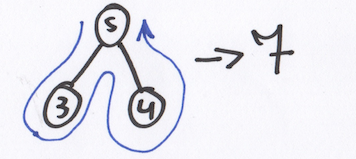
Mu interpreter will go through its AST and calculate the values, applying the operator to the child nodes.
Publication Support - Edison , a company specializing in automation of asphalt plants and the development of payment systems and terminals .
Writing your programming language (in Swift)
In order to write your own programming language, it is not necessary to have a degree in Computer Science, it is enough to understand 3 basic steps.
Language: Mu (μ)
Mu is a minimal language that contains a postfix operator, a binary operation, and "one-digit" numbers.
Example: (s 2 4) or (s (s 4 5) 4) or (s (s 4 5) (s 3 2)) ...
Steps:
- Lexer
- Parser
- Interpreter
Lexer
In computer science, lexical analysis is the process of analytic analysis of an input sequence of characters (for example, such as source code in one of the programming languages) in order to obtain a sequence of characters called “tokens” (like a grouping of letters in words).
The group of characters of the input sequence, identified at the output of the process as a token, is called a token. In the process of lexical analysis, recognition and selection of tokens from the input sequence of characters is performed.
- Wikipedia
Example:
Due to the fact that
Muit is so small - only one operator and numbers - you can just iterate through the input and check each character.enum Token {
case parensOpen
case op(String)
case number(Int)
case parensClose
}
struct Lexer {
static func tokenize(_ input: String) -> [Token] {
return input.characters.flatMap {
switch $0 {
case "(": return Token.parensOpen
case ")": return Token.parensClose
case "s": return Token.op($0.description)
default:
if "0"..."9" ~= $0 {
return Token.number(Int($0.description)!)
}
}
return nil
}
}
}
let input = "(s (s 4 5) 4)"
let tokens = Lexer.tokenize(input)
Parser
A parser or parser is a part of a program that converts input data (usually text) into a structured format. The parser parses the text.
Grammar:
expression: parensOpen operator primaryExpression primaryExpression parensClose
primaryExpression: expression | number
parensOpen: "("
parensClose: ")"
operator: "s"
number: [0-9]
Grammar
Muis a non-contextual grammar, which means that it describes all possible variations of strings in the language. The parser starts from the top (the root of the generated tree) and moves to the bottom node. Tip: The code should be a direct representation of the grammar.
func parseExpression() -> ExpressionNode {
   ...
   firstPrimaryExpression = parsePrimaryExpression()
   secondPrimaryExpression = parsePrimaryExpression()
   ...
}
func parseExpression() -> PrimaryExpressionNode {
   return parseExpression() || parseNumber()
}
indirect enum PrimaryExpressionNode {
case number(Int)
case expression(ExpressionNode)
}
struct ExpressionNode {
var op: String
var firstExpression: PrimaryExpressionNode
var secondExpression: PrimaryExpressionNode
}
struct Parser {
var index = 0
let tokens: [Token]
init(tokens: [Token]) {
self.tokens = tokens
}
mutating func popToken() -> Token {
let token = tokens[index]
index += 1
return token
}
mutating func peekToken() -> Token {
return tokens[index]
}
mutating func parse() throws -> ExpressionNode {
return try parseExpression()
}
mutating func parseExpression() throws -> ExpressionNode {
guard case .parensOpen = popToken() else {
throw ParsingError.unexpectedToken
}
guard case let Token.op(_operator) = popToken() else {
throw ParsingError.unexpectedToken
}
let firstExpression = try parsePrimaryExpression()
let secondExpression = try parsePrimaryExpression()
guard case .parensClose = popToken() else {
throw ParsingError.unexpectedToken
}
return ExpressionNode(op: _operator, firstExpression: firstExpression, secondExpression: secondExpression)
}
mutating func parsePrimaryExpression() throws -> PrimaryExpressionNode {
switch peekToken() {
case .number:
return try parseNumber()
case .parensOpen:
let expressionNode = try parseExpression()
return PrimaryExpressionNode.expression(expressionNode)
default:
throw ParsingError.unexpectedToken
}
}
mutating func parseNumber() throws -> PrimaryExpressionNode {
guard case let Token.number(n) = popToken() else { throw ParsingError.unexpectedToken }
return PrimaryExpressionNode.number(n)
}
}
//MARK: Utils
extension ExpressionNode: CustomStringConvertible {
public var description: String {
return "\(op) -> [\(firstExpression), \(secondExpression)]"
}
}
extension PrimaryExpressionNode: CustomStringConvertible {
public var description: String {
switch self {
case .number(let n): return n.description
case .expression(let exp): return exp.description
}
}
}
let input = "(s 2 (s 3 5))"
let tokens = Lexer.tokenize(input)
var parser = Parser(tokens: tokens)
var ast = try! parser.parse()Interpreter
In computer science, an interpreter is a program that sequentially executes instructions written in a programming language or scripting language, without first compiling it into machine code. (Wikipedia)
Example:
Mu interpreter will go through its AST and calculate the values, applying the operator to the child nodes.
enum InterpreterError: Error {
    case unknownOperator
}
struct Interpreter {
    static func eval(_ expression: ExpressionNode) throws -> Int {
        let firstEval = try eval(expression.first)
        let secEval = try eval(expression.second)
        if expression.op == "s" {
            return firstEval + secEval
        }
        throw InterpreterError.unknownOperator
    }
    static func eval(_ prim: PrimaryExpressionNode) throws -> Int {
        switch prim {
        case .expression(let exp):
            return try eval(exp)
        case .number(let n):
            return Int(n)
        }
    }
}
let input = "(s (s 5 2) 4)"
let tokens = Lexer.tokenize(input)
var parser = Parser(tokens: tokens)
let ast = try! parser.parse()
try! Interpreter.eval(ast)
Conclusion
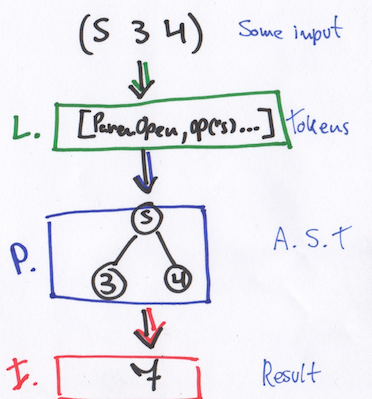
- Enter
let input = "(s (s 4 5) 4) - Retrieving an Array of Tokens (Lexing)
let tokens = Lexer.tokenize(input) - Parsing received tokens into a tree (Parsing).
var parser = Parser(tokens: tokens)
let ast = try! parser.parse()- We walk through the tree, calculating the values inside the nodes (Interpreting).
let result = try! Interpreter.eval(ast)
Resources
- ruslanspivak.com/lsbasi-part1
- www.amazon.com/Compilers-Principles-Techniques-Tools-2nd/dp/0321486811
- llvm.org/docs/tutorial
Publication Support - Edison , a company specializing in automation of asphalt plants and the development of payment systems and terminals .