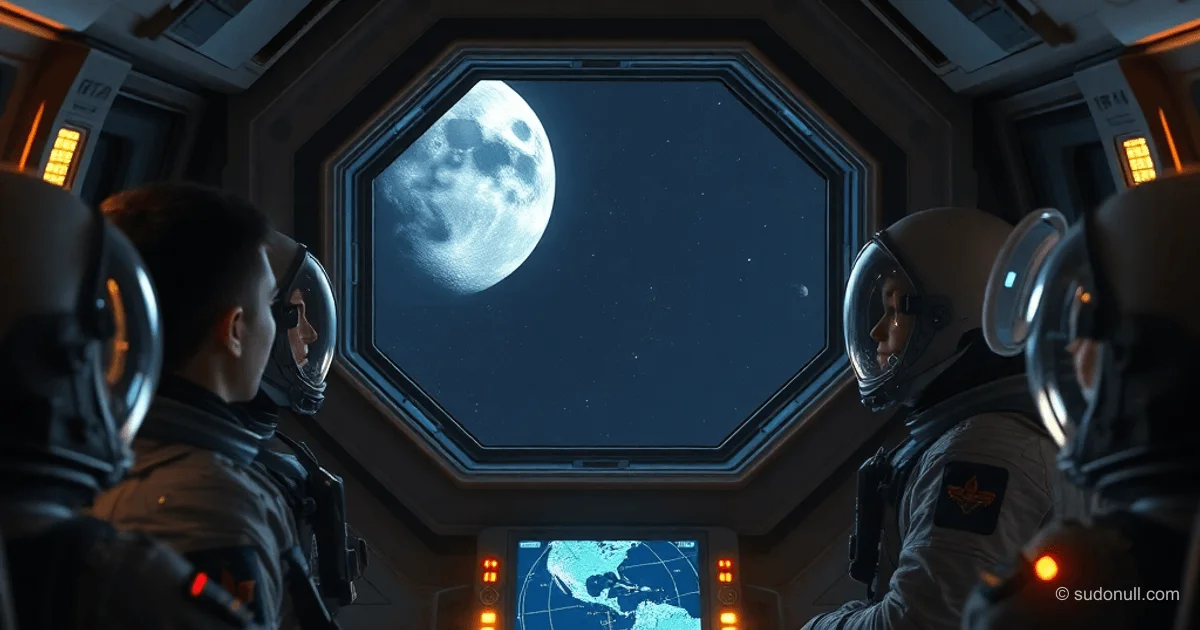
Artemis 2: Orion's First Crewed Mission to the Moon
The SLS rocket with the Orion spacecraft launched from Launch Complex 39B in Florida, sending four astronauts on a trajectory to the Moon. This is the first crewed flight to the Moon since 1972, following Apollo 17. The mission tests deep-space systems in real conditions with a crew on board: life support, navigation, power, and maneuvering.
Orion will not land on the surface but will perform a lunar flyby, reaching a maximum distance of 402,000 km from Earth. The duration is about 10 days, ending with a splashdown in the Pacific Ocean. The primary goal is to confirm the spacecraft's reliability for future lunar landings and bases.
Crew and Their Qualifications
The crew includes experienced specialists:
- Reid Wiseman (commander): 165 days in space, spacewalks, flight on Soyuz.
- Victor Glover: Naval aviator with piloting experience.
- Christina Koch: Record 328 days on the ISS, work at an Antarctic station.
- Jeremy Hansen: Canadian astronaut, physicist, military pilot—the first Canadian on a lunar trajectory.
The composition reflects the international approach of the Artemis program, with partners like ESA.
Orion Spacecraft Design
Orion consists of two modules:
Crew module (capsule for return):
- Seats, control panels, navigation, communication, displays.
- Life support systems, supplies, emergency protocols.
Service module (developed by ESA):
- Engines for maneuvers (including Trans-Lunar Injection).
- Power, water, ventilation, thermal regulation.
The service module ensures autonomy in deep space, where external assistance is impossible.
Flight Timeline
- Two orbits around Earth: System checks after separation from SLS.
- Trans-Lunar Injection (TLI): Acceleration by engines to enter lunar trajectory.
- Journey through deep space: Testing autonomy, communication, power consumption, living conditions.
- Lunar flyby: Gravitational maneuver, navigation in cislunar space, surface observation.
- Return: Gravitational braking, atmospheric entry at record speed (heat shield).
The mission overcame delays due to hydrogen leaks, heat shield issues, and helium lines.
Current Status and Incidents
The flight is proceeding as planned. Notable events:
- Temporary loss of communication.
- Malfunction in the waste ventilation system controller—resolved by the crew.
- Closed water tank valve.
These events test system resilience in real time.
Future Artemis Missions
After Artemis 2:
- 2027: Artemis 3—orbital tests for landing.
- 2028: Artemis 4—first landing, scientific research.
- Artemis 5 and beyond: Infrastructure for lunar base, resource extraction, preparation for Mars.
The program lays the foundation for sustainable presence beyond Earth.
Key Takeaways
- First crewed test of Orion confirms readiness for deep-space missions.
- ESA's service module is critical for autonomy in deep space.
- Crew with international experience demonstrates collaboration in Artemis.
- Maximum distance—402,000 km, a record for crewed spacecraft.
- Onboard incidents (ventilation, water) successfully resolved by the crew.
— Editorial Team










No comments yet.