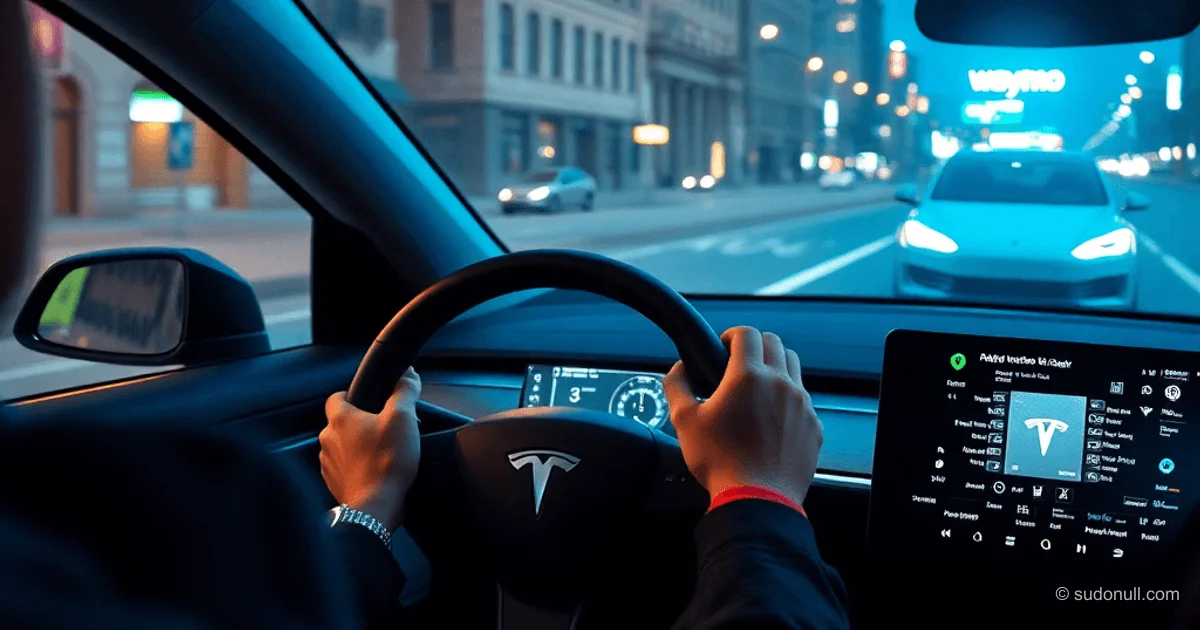
# California Classifies Tesla's Ride-Hailing Service as Standard Ridesharing, Not Robotaxi
The California Public Utilities Commission (CPUC) has officially classified Tesla's ride-hailing service as a standard driver service, similar to limo rentals. This exempts the company from safety reporting requirements applied to operators of fully autonomous systems like Waymo and Zoox. Pat Zen, CPUC's Deputy Executive Director, confirmed: Tesla uses an SAE Level 2 system, where AI cannot navigate independently without constant human oversight.
In California, autonomous vehicles are defined as SAE Level 3 and above—the onboard system must navigate in given conditions without driver intervention. Tesla received a TCP (Transportation Charter-Party) permit, typical for limos, where the person behind the wheel is considered the primary driver, not a supervised operator.
Differences in Regulation and Reporting
Operators of SAE Level 3+ robotaxis must provide CPUC with detailed data for each trip: geolocation, number of passengers, mileage, idle time, and disengagements (stops over 2 minutes or requiring remote intervention). These reports are published quarterly.
Tesla is exempt from such requirements. The service in the San Francisco Bay Area operates without transparency on safety data, despite being marketed as a "robotaxi." Zen noted: even with driver assistance systems, the driver remains responsible.
- Advantages of Full Autonomy (SAE 3+): mandatory reporting ensures public oversight.
- Limitations of SAE 2: driver supervision function, like Uber with driver assists.
- Implications for Tesla: lack of data hides real safety performance.
Timeline of Tesla's Service Development
In early 2025, Tesla applied to launch a taxi service with human drivers and received its TCP permit in March. While CPUC was developing the rules, the company lobbied to exclude Level 2 data from reporting requirements, citing them as "burdensome."
In February 2026 comments to CPUC, Tesla acknowledged using in-cab drivers and remote operators in Austin and San Francisco. At the same time, it insisted on the right to use marketing terms like "driverless" and "robotaxi" for SAE Level 2.
Waymo, by contrast, operates fully driverless vehicles, handling 450,000 paid trips per week with full reporting.
Safety Issues and Incidents
In January 2026, in Austin, Tesla moved the safety monitoring system from the robotaxi cabin to a chase vehicle. This coincided with Elon Musk's claims of having "solved autonomous driving."
Users posted videos showing the safety driver dozing off, triggering audio alerts. The company did not respond.
Crash data in Austin: 14 incidents over 800,000 miles, or 1 crash every 57,000 miles. That's 4 times worse than the average human driver.
- Crash Frequency: 57k miles per incident vs. human average.
- Risk Factors: dozing drivers, remote control.
- Comparison to Waymo: full autonomy with transparent metrics.
Key Points
- CPUC classifies Tesla as driver services (TCP), excluding it from robotaxi reporting.
- SAE Level 2 doesn't meet California's definition of autonomy (requires SAE 3+).
- Lack of data masks safety issues: 14 crashes over 800k miles in Austin.
- Tesla lobbies for marketing terms without transparency obligations.
- Waymo shows the full autonomy model with 450k weekly trips.
— Editorial Team










No comments yet.