
 February 14, 2014 at 17:27
Sport and some linear equations
This text is written exclusively for Habr and contains my personal experience, funny facts and some advertising.

lurkmo.re/_/8821#mws_XtuVv4a
First, the background.
I never attached much importance to my physical development and it seemed to me pretty boring to spend my time playing sports. I believed that my form is within normal limits and sex is enough to burn extra calories. And I really almost did not think about sports until the age of 30 with a little. But gradually dissatisfaction with my body accumulated, and I well remembered the turning point. That day I bought a large double wardrobe in ikey, brought it home and tried to assemble it. After 6 hours, I was lying on the floor, breathing heavily, and thought that I was no longer a teenager and most definitely should reconsider my attitude to physical development.
Since I love games, and my work is related to games, then I will use game terms. I apologize in advance to those who find this inappropriate.
Let's start with “maximizing the pros."
I try to systematically approach things that are important to me and therefore, for some time I studied the theory of the issue. As a result, I identified three main paths. Conventionally, they can be divided into casual, midcore and hardcore. Casual is a pool, running, rollers, group classes, sports, yoga, etc. Midcore is rocking, and hardcore is rocking + farm. The Kazhaul option seemed very tempting, but was regretfully rejected for poor performance. Yes, it’s quite fun, but achieving the same physical form takes an order of magnitude more time than with strength training. Those who plan to participate in competitions, or, for example, actors who urgently need to pump up for a role in the film, use the hardcore option, but the pharma in my eyes has too many disadvantages: the pharma affects the fragile hormonal balance of the body, It requires constant monitoring by a doctor and passing tests, has a bad effect on the emotional sphere and is not entirely legal. Having appreciated all the pros and cons, I chose the midcore option.
I was lucky right away and, on my very first trip to the rocking chair, I met an excellent coach (Dima, hi). He was inspired by the seriousness of my intentions and set out to help me. The first four months were very difficult. Both physically and mentally. I survived only thanks to the professionalism of the coach. He gave great, but acceptable for me loads and supported psychologically, simultaneously dispelling a lot of myths carried by casuals. Most people think that their shape will begin to improve from the first lesson, expose themselves to extreme loads and quickly quit without getting a result. In fact, it only takes a few months to learn how to do the exercises correctly and develop the necessary stamina. The next revelation for me was that the direct path does not work. In order to lose weight (i.e. get rid of fat),
Here is a somewhat simplified picture of how the body works. Energy (calories) is spent on supporting life and physical activity. If more calories are consumed in the body with food than consumed, then some of the excess is deposited in the form of fat. This mechanism appeared as a result of evolution and allowed people to survive during periods of hunger. And if at the moment the problem of hunger receded into the background, then the ancient schemes laid down in us have nothing to do with it. Therefore, most of the effort is actually spent on “tricking” the body. It would seem that you can limit the flow of calories and then the fat will not accumulate. This is not entirely true. If calorie consumption is greater than what comes with food, then the body needs to make up for the deficiency somewhere. Part of the energy (small) of course will be taken from stored fats, but nature has arranged it so that, first of all, the body will get rid of the most useless and energy-intensive, namely the muscles. What are muscles for? If you look from the point of view of calorie expenditure, then this is the only (well, almost) our parameter that we can influence. If we want to significantly increase our metabolism (energy expenditure), then we need a lot of muscle. Thus, increasing muscle mass and preventing fats from accumulating, we can gradually shift the balance towards good shape. In practice, it is not the simultaneous pumping and fat burning that is more effective, but the cycles of weight gain and drying. then this is the only (well, almost) our parameter that we can influence. If we want to significantly increase our metabolism (energy expenditure), then we need a lot of muscle. Thus, increasing muscle mass and preventing fats from accumulating, we can gradually shift the balance towards good shape. In practice, it is not the simultaneous pumping and fat burning that is more effective, but the cycles of weight gain and drying. then this is the only (well, almost) our parameter that we can influence. If we want to significantly increase our metabolism (energy expenditure), then we need a lot of muscle. Thus, increasing muscle mass and preventing fats from accumulating, we can gradually shift the balance towards good shape. In practice, it is not the simultaneous pumping and fat burning that is more effective, but the cycles of weight gain and drying.
So, after a few months, I got used to three workouts a week and began to gradually build muscle. Things were not going well, and I began to think about how to improve the efficiency of this process. And then food came to the fore. As I said in the previous paragraph, it is very important that the amount of nutrients that enter the body match their needs as closely as possible. It turns out that this can be calculated. There are formulas that take into account different parameters such as weight, height, etc. There are also instruments that measure metabolism. It doesn’t matter where to start, as we will get the exact values a bit later. Having learned your approximate daily calorie intake, you can go further, namely, to calculate how many proteins, fats and carbohydrates you need to eat every day. For muscle growth, it is recommended to eat from 2 grams of protein per kilogram of body weight. Fat at a minimum, 1 gram per kilogram of body weight or less, and the rest is carbohydrates. By the way, it turned out that fats are also necessary for the normal functioning of the body, although there was a temptation to not eat them at all. Having received three numbers, I tried to correlate them with real products. After tormenting myself for several days with calculations on a piece of paper, I asked the trainer whether it is possible to somehow simplify this process, what if there is some special software on this subject? He said that most athletes use a rather limited menu, literally 3-4 products and therefore it’s not so difficult for them to choose the exact amount to eat their norm. I tried. I had enough for a couple of weeks, my diet consisted of chicken breast, rice, cottage cheese and oatmeal. I decided that my willpower is quite finite and I am not ready to subject it to such tests. It was necessary to somehow diversify my food, without reducing the effectiveness of the diet. A little googling, I was surprised to find no convenient tool that would solve this problem. Of course, there were many applications for accounting for eaten foods, but they did not give any bonuses compared to counting on a piece of paper. The big drawback of such a system was that I could hardly eat outside the house. Any trip to a restaurant or cafe, in the middle of the day, completely crossed out the planned diet. It was necessary to be able to quickly make adjustments to the planned menu, based on the availability of certain dishes and products. but they did not give any bonuses in comparison with the count on a piece of paper. The big drawback of such a system was that I could hardly eat outside the house. Any trip to a restaurant or cafe, in the middle of the day, completely crossed out the planned diet. It was necessary to be able to quickly make adjustments to the planned menu, based on the availability of certain dishes and products. but they did not give any bonuses in comparison with the count on a piece of paper. The big drawback of such a system was that I could hardly eat outside the house. Any trip to a restaurant or cafe, in the middle of the day, completely crossed out the planned diet. It was necessary to be able to quickly make adjustments to the planned menu, based on the availability of certain dishes and products.
The ideal solution was a mobile application that would contain a list of products with information on the amount of nutrients, allow you to quickly edit this list, add or remove the amount of each product, and also instantly reduce the daily balance. Almost immediately, the idea came to realize this in the form of a list of sliders (by the number of products). The user can move one of the sliders, and the application adjusts the position of the others, but so that the total amount of proteins, fats and carbohydrates throughout the list exactly matches the plan. The problem was reduced to solving a simple system of linear equations, with some restrictions on the solution domain. So the first version of the nutritionist appeared.
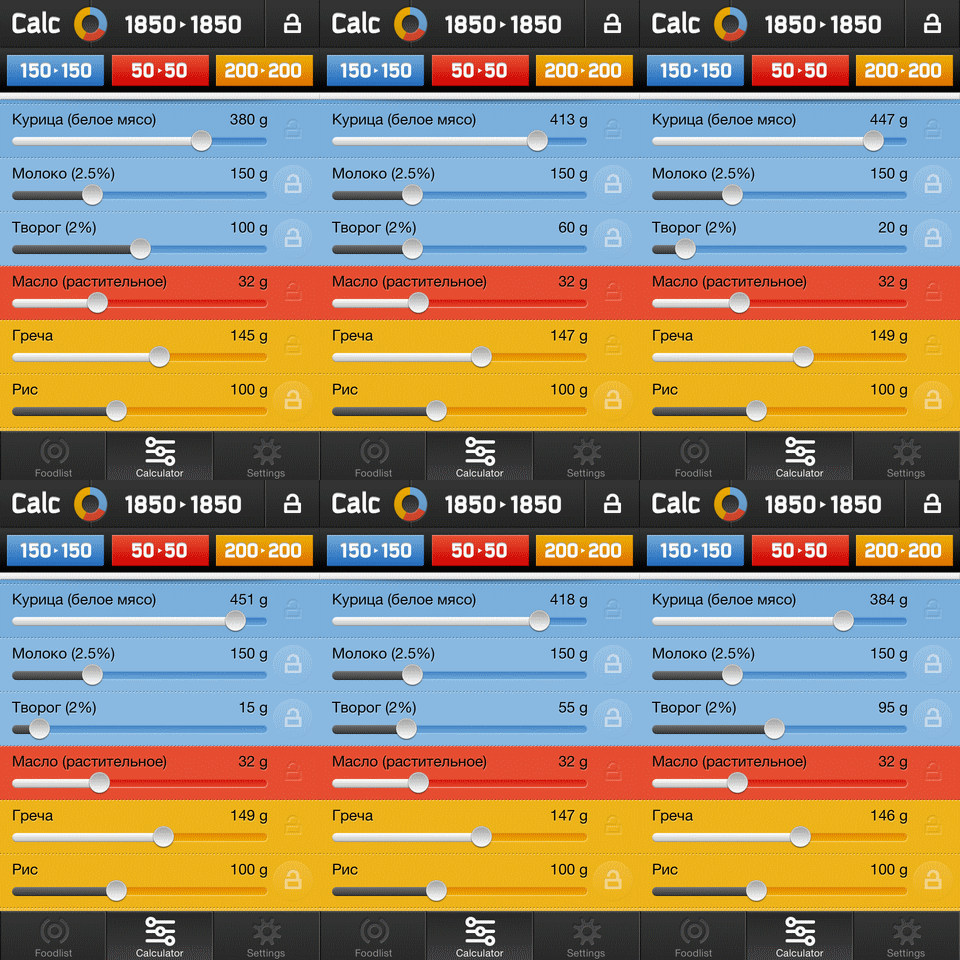
The application was made, as they say, for myself, so it looked then a little different. However, my trainer and I very quickly appreciated the convenience and speed of diet planning in a dietician, and gradually relatives, friends and other visitors to the gym joined the circle of initiates. Testing and improvements took over a year. The process revealed a lot of interesting details. For example, what is the glycemic index and how fast carbohydrates differ from slow carbohydrates, why not all proteins are the same and that fats are saturated and unsaturated, and which ones are useful. The application interface has been radically improved in all aspects, and the solver has become much smarter. At some point, I was tired of sending invitations to TestFlight, and I decided that the Dietograph was ready for uploading to the app.
After I began to control the diet, some results appeared, looking ahead, I can say that I managed to gain 10 kg of meat in six months, which is pretty good for my weight (before the start of classes it was 62 kg, and at the end of weight gain became 76 kg, for beginners it happens). And it took me about a year (and two cycles with drying) to get the “relief press” achievements.
If someone decides to repeat my method, then I will tell you some life hacks. Since it is quite difficult to find out the exact individual value of the daily calorie intake, an iterative method is suitable. First you need to calculate the value using one of three formulas (the button “metabolism calculator”), either find it on the Internet or ask your trainer. Then you need to enter the data into the daily diet calculator and carefully follow this diet for a couple of weeks, while weighing every 2-3 days. If the weight falls, then you need to eat more and more often, if it grows, then you can eat less. It is necessary to add and reduce gradually, no more than 200-300 calories per week. The body is quite an inertial thing, so you almost always need to wait a couple of weeks to notice the changes. If the weight has stabilized, then we found the desired values and you can choose what to do next, for example, gain weight. By the way, I was seriously malnourished when I was oriented on my feelings and appetite. In general, this is a rather counter-intuitive thing; you cannot completely trust yourself in this matter; it’s better to just count. Another funny fact is that an unprepared person is completely unable to estimate the weight of the products by eye, the error is usually up to 50%, which completely makes the diet meaningless. Therefore, weigh all products (at least until the eye has developed). which completely deprives the diet of meaning. Therefore, weigh all products (at least until the eye has developed). which completely deprives the diet of meaning. Therefore, weigh all products (at least until the eye has developed).
It is very important to eat evenly throughout the day. The more meals, the better. It is necessary, as it were, to convince the body that hunger does not threaten him and there is no sense in putting off supplies for a rainy day. Muscle growth also requires a constant supply of nutrients, which is why many athletes eat protein foods at bedtime, and some even wake up specially at night to drink a protein shake.
Just in case, I repeat that diet makes sense only in conjunction with sports. Separately, this does not work.
So, let's say you want to do strength training and diet. Suppose you don’t (like mine) have special genetic bonuses or a penalty to the constitution, and you want to achieve visible results in a year. What should you be prepared for? First of all, these are costs. The cost of time and money.
Firstly, you need time for training. I settled on three classes in the gym per week. More than three do not give noticeable bonuses (excluding the drying period, of course). Total, get to the hall, work out (an hour and a half), then a hitch (20 minutes), shower and get back. Do not skip. At all. Personally, I have one lesson with the road takes about 3 hours. Secondly, a huge amount of time will be taken by the preparation and absorption of food. An ordinary person can eat bigmack on the way home and drink it with beer. It will not suit you. You will have to plan in advance at least a four-time meal, and then painfully push into yourself this huge amount of food. If the wife or the slow cooker can handle the cooking, then you will have to eat it all yourself. I think you can safely evaluate all this at 3 o’clock every day.
As for money, I’ll try to calculate the approximate budget using the example of St. Petersburg. A gym membership can cost from 5,000 to 35,000 rubles per year. An expensive hall does not give any bonuses for pumping, but it can be more comfortable or just closer to home. Personal training. For beginners, it's just “a must.” I believe that it is absolutely impossible to learn how to do the exercises correctly and calculate the program without having the appropriate experience. You will simply waste time or even harm yourself. A good coach will be able to protect you from injuries, optimize loads in real time and help psychologically. In addition, working with a trainer, there are much more chances not to quit and hold out this year. Personal training costs a lot, 500-1500 rubles per lesson. You need to buy 30-150 workouts per year. The next item of expenditure is food. If carbohydrates and fats are relatively cheap, then high-quality protein foods cost decent money. It’s good if you can eat chicken breasts all year round (100-200 rubles per kilogram), but if you want variety, then beef is already more expensive (up to 400 rubles), and fresh tuna can cost 500-700 rubles. If you have to dine in a cafe, you can safely multiply all prices by 2 or 3. For a character weighing 75 kg, about 150 grams per day is required. protein, and such an amount is contained in approximately 750 grams of meat or cottage cheese. and fresh tuna can cost 500-700 rubles. If you have to dine in a cafe, you can safely multiply all prices by 2 or 3. For a character weighing 75 kg, about 150 grams per day is required. protein, and such an amount is contained in approximately 750 grams of meat or cottage cheese. and fresh tuna can cost 500-700 rubles. If you have to dine in a cafe, you can safely multiply all prices by 2 or 3. For a character weighing 75 kg, about 150 grams per day is required. protein, and such an amount is contained in approximately 750 grams of meat or cottage cheese.
Take the average values and summarize for the year.
Subscription: 20 000 rubles.
Trainer: 1000 * 90 = 90 000 rubles.
Food: 300 * 365 = 109 500 rubles.
Application “Dietograph”: 329 rubles.
Total: 219,829 rubles.
Of course, I did not take into account everything here, and someone will find ways to save money, but seriously speaking, this project has a rather serious budget. On the other hand, if you are not fully committed to the business, then you will need many times more time to achieve the same results (if at all). Therefore, even in terms of money, it makes sense to plow in full, not to mention irreplaceable time.
For those readers who have mastered this wall of text, I want to summarize some of the results. The theme of sports and nutrition is truly huge and rich in holivars. It would be foolish to claim the ultimate truth. However, this is my personal and distressed experience. All the techniques and techniques described above actually work and show good effectiveness, which was tested on myself and several other volunteers. In addition, numerous consultations with specialists have convinced me that all this is completely safe for health.
As for the application, it is made for iPhone and iPod, written in a mixture of C ++ and ObjC, so I can not imagine how to port it to Android or WP, if I just rewrite it. The application is paid for several reasons. Firstly, I want to recoup the costs of design and other direct costs, and secondly, people who value it for free get much less (I can say that if I found a similar application when I started playing sports, I would not regret the amount an order of magnitude greater). Thirdly, the price of the application is ridiculous along with the rest of the sports expenses. However, if religion or other factors do not allow you to use paid applications, then I am ready to send promotional codes to the first 50 who applied, but with the condition to send me a report on your personal experience of pumping, say, in six months.
Link:
itunes.apple.com/en/app/dietograph-pro-diet-planner/id808769413?mt=8
I will be glad to answer questions from readers.
lurkmo.re/_/8821#mws_XtuVv4a
First, the background.
I never attached much importance to my physical development and it seemed to me pretty boring to spend my time playing sports. I believed that my form is within normal limits and sex is enough to burn extra calories. And I really almost did not think about sports until the age of 30 with a little. But gradually dissatisfaction with my body accumulated, and I well remembered the turning point. That day I bought a large double wardrobe in ikey, brought it home and tried to assemble it. After 6 hours, I was lying on the floor, breathing heavily, and thought that I was no longer a teenager and most definitely should reconsider my attitude to physical development.
Since I love games, and my work is related to games, then I will use game terms. I apologize in advance to those who find this inappropriate.
Let's start with “maximizing the pros."
I try to systematically approach things that are important to me and therefore, for some time I studied the theory of the issue. As a result, I identified three main paths. Conventionally, they can be divided into casual, midcore and hardcore. Casual is a pool, running, rollers, group classes, sports, yoga, etc. Midcore is rocking, and hardcore is rocking + farm. The Kazhaul option seemed very tempting, but was regretfully rejected for poor performance. Yes, it’s quite fun, but achieving the same physical form takes an order of magnitude more time than with strength training. Those who plan to participate in competitions, or, for example, actors who urgently need to pump up for a role in the film, use the hardcore option, but the pharma in my eyes has too many disadvantages: the pharma affects the fragile hormonal balance of the body, It requires constant monitoring by a doctor and passing tests, has a bad effect on the emotional sphere and is not entirely legal. Having appreciated all the pros and cons, I chose the midcore option.
I was lucky right away and, on my very first trip to the rocking chair, I met an excellent coach (Dima, hi). He was inspired by the seriousness of my intentions and set out to help me. The first four months were very difficult. Both physically and mentally. I survived only thanks to the professionalism of the coach. He gave great, but acceptable for me loads and supported psychologically, simultaneously dispelling a lot of myths carried by casuals. Most people think that their shape will begin to improve from the first lesson, expose themselves to extreme loads and quickly quit without getting a result. In fact, it only takes a few months to learn how to do the exercises correctly and develop the necessary stamina. The next revelation for me was that the direct path does not work. In order to lose weight (i.e. get rid of fat),
Here is a somewhat simplified picture of how the body works. Energy (calories) is spent on supporting life and physical activity. If more calories are consumed in the body with food than consumed, then some of the excess is deposited in the form of fat. This mechanism appeared as a result of evolution and allowed people to survive during periods of hunger. And if at the moment the problem of hunger receded into the background, then the ancient schemes laid down in us have nothing to do with it. Therefore, most of the effort is actually spent on “tricking” the body. It would seem that you can limit the flow of calories and then the fat will not accumulate. This is not entirely true. If calorie consumption is greater than what comes with food, then the body needs to make up for the deficiency somewhere. Part of the energy (small) of course will be taken from stored fats, but nature has arranged it so that, first of all, the body will get rid of the most useless and energy-intensive, namely the muscles. What are muscles for? If you look from the point of view of calorie expenditure, then this is the only (well, almost) our parameter that we can influence. If we want to significantly increase our metabolism (energy expenditure), then we need a lot of muscle. Thus, increasing muscle mass and preventing fats from accumulating, we can gradually shift the balance towards good shape. In practice, it is not the simultaneous pumping and fat burning that is more effective, but the cycles of weight gain and drying. then this is the only (well, almost) our parameter that we can influence. If we want to significantly increase our metabolism (energy expenditure), then we need a lot of muscle. Thus, increasing muscle mass and preventing fats from accumulating, we can gradually shift the balance towards good shape. In practice, it is not the simultaneous pumping and fat burning that is more effective, but the cycles of weight gain and drying. then this is the only (well, almost) our parameter that we can influence. If we want to significantly increase our metabolism (energy expenditure), then we need a lot of muscle. Thus, increasing muscle mass and preventing fats from accumulating, we can gradually shift the balance towards good shape. In practice, it is not the simultaneous pumping and fat burning that is more effective, but the cycles of weight gain and drying.
So, after a few months, I got used to three workouts a week and began to gradually build muscle. Things were not going well, and I began to think about how to improve the efficiency of this process. And then food came to the fore. As I said in the previous paragraph, it is very important that the amount of nutrients that enter the body match their needs as closely as possible. It turns out that this can be calculated. There are formulas that take into account different parameters such as weight, height, etc. There are also instruments that measure metabolism. It doesn’t matter where to start, as we will get the exact values a bit later. Having learned your approximate daily calorie intake, you can go further, namely, to calculate how many proteins, fats and carbohydrates you need to eat every day. For muscle growth, it is recommended to eat from 2 grams of protein per kilogram of body weight. Fat at a minimum, 1 gram per kilogram of body weight or less, and the rest is carbohydrates. By the way, it turned out that fats are also necessary for the normal functioning of the body, although there was a temptation to not eat them at all. Having received three numbers, I tried to correlate them with real products. After tormenting myself for several days with calculations on a piece of paper, I asked the trainer whether it is possible to somehow simplify this process, what if there is some special software on this subject? He said that most athletes use a rather limited menu, literally 3-4 products and therefore it’s not so difficult for them to choose the exact amount to eat their norm. I tried. I had enough for a couple of weeks, my diet consisted of chicken breast, rice, cottage cheese and oatmeal. I decided that my willpower is quite finite and I am not ready to subject it to such tests. It was necessary to somehow diversify my food, without reducing the effectiveness of the diet. A little googling, I was surprised to find no convenient tool that would solve this problem. Of course, there were many applications for accounting for eaten foods, but they did not give any bonuses compared to counting on a piece of paper. The big drawback of such a system was that I could hardly eat outside the house. Any trip to a restaurant or cafe, in the middle of the day, completely crossed out the planned diet. It was necessary to be able to quickly make adjustments to the planned menu, based on the availability of certain dishes and products. but they did not give any bonuses in comparison with the count on a piece of paper. The big drawback of such a system was that I could hardly eat outside the house. Any trip to a restaurant or cafe, in the middle of the day, completely crossed out the planned diet. It was necessary to be able to quickly make adjustments to the planned menu, based on the availability of certain dishes and products. but they did not give any bonuses in comparison with the count on a piece of paper. The big drawback of such a system was that I could hardly eat outside the house. Any trip to a restaurant or cafe, in the middle of the day, completely crossed out the planned diet. It was necessary to be able to quickly make adjustments to the planned menu, based on the availability of certain dishes and products.
The ideal solution was a mobile application that would contain a list of products with information on the amount of nutrients, allow you to quickly edit this list, add or remove the amount of each product, and also instantly reduce the daily balance. Almost immediately, the idea came to realize this in the form of a list of sliders (by the number of products). The user can move one of the sliders, and the application adjusts the position of the others, but so that the total amount of proteins, fats and carbohydrates throughout the list exactly matches the plan. The problem was reduced to solving a simple system of linear equations, with some restrictions on the solution domain. So the first version of the nutritionist appeared.
The application was made, as they say, for myself, so it looked then a little different. However, my trainer and I very quickly appreciated the convenience and speed of diet planning in a dietician, and gradually relatives, friends and other visitors to the gym joined the circle of initiates. Testing and improvements took over a year. The process revealed a lot of interesting details. For example, what is the glycemic index and how fast carbohydrates differ from slow carbohydrates, why not all proteins are the same and that fats are saturated and unsaturated, and which ones are useful. The application interface has been radically improved in all aspects, and the solver has become much smarter. At some point, I was tired of sending invitations to TestFlight, and I decided that the Dietograph was ready for uploading to the app.
After I began to control the diet, some results appeared, looking ahead, I can say that I managed to gain 10 kg of meat in six months, which is pretty good for my weight (before the start of classes it was 62 kg, and at the end of weight gain became 76 kg, for beginners it happens). And it took me about a year (and two cycles with drying) to get the “relief press” achievements.
If someone decides to repeat my method, then I will tell you some life hacks. Since it is quite difficult to find out the exact individual value of the daily calorie intake, an iterative method is suitable. First you need to calculate the value using one of three formulas (the button “metabolism calculator”), either find it on the Internet or ask your trainer. Then you need to enter the data into the daily diet calculator and carefully follow this diet for a couple of weeks, while weighing every 2-3 days. If the weight falls, then you need to eat more and more often, if it grows, then you can eat less. It is necessary to add and reduce gradually, no more than 200-300 calories per week. The body is quite an inertial thing, so you almost always need to wait a couple of weeks to notice the changes. If the weight has stabilized, then we found the desired values and you can choose what to do next, for example, gain weight. By the way, I was seriously malnourished when I was oriented on my feelings and appetite. In general, this is a rather counter-intuitive thing; you cannot completely trust yourself in this matter; it’s better to just count. Another funny fact is that an unprepared person is completely unable to estimate the weight of the products by eye, the error is usually up to 50%, which completely makes the diet meaningless. Therefore, weigh all products (at least until the eye has developed). which completely deprives the diet of meaning. Therefore, weigh all products (at least until the eye has developed). which completely deprives the diet of meaning. Therefore, weigh all products (at least until the eye has developed).
It is very important to eat evenly throughout the day. The more meals, the better. It is necessary, as it were, to convince the body that hunger does not threaten him and there is no sense in putting off supplies for a rainy day. Muscle growth also requires a constant supply of nutrients, which is why many athletes eat protein foods at bedtime, and some even wake up specially at night to drink a protein shake.
Just in case, I repeat that diet makes sense only in conjunction with sports. Separately, this does not work.
So, let's say you want to do strength training and diet. Suppose you don’t (like mine) have special genetic bonuses or a penalty to the constitution, and you want to achieve visible results in a year. What should you be prepared for? First of all, these are costs. The cost of time and money.
Firstly, you need time for training. I settled on three classes in the gym per week. More than three do not give noticeable bonuses (excluding the drying period, of course). Total, get to the hall, work out (an hour and a half), then a hitch (20 minutes), shower and get back. Do not skip. At all. Personally, I have one lesson with the road takes about 3 hours. Secondly, a huge amount of time will be taken by the preparation and absorption of food. An ordinary person can eat bigmack on the way home and drink it with beer. It will not suit you. You will have to plan in advance at least a four-time meal, and then painfully push into yourself this huge amount of food. If the wife or the slow cooker can handle the cooking, then you will have to eat it all yourself. I think you can safely evaluate all this at 3 o’clock every day.
As for money, I’ll try to calculate the approximate budget using the example of St. Petersburg. A gym membership can cost from 5,000 to 35,000 rubles per year. An expensive hall does not give any bonuses for pumping, but it can be more comfortable or just closer to home. Personal training. For beginners, it's just “a must.” I believe that it is absolutely impossible to learn how to do the exercises correctly and calculate the program without having the appropriate experience. You will simply waste time or even harm yourself. A good coach will be able to protect you from injuries, optimize loads in real time and help psychologically. In addition, working with a trainer, there are much more chances not to quit and hold out this year. Personal training costs a lot, 500-1500 rubles per lesson. You need to buy 30-150 workouts per year. The next item of expenditure is food. If carbohydrates and fats are relatively cheap, then high-quality protein foods cost decent money. It’s good if you can eat chicken breasts all year round (100-200 rubles per kilogram), but if you want variety, then beef is already more expensive (up to 400 rubles), and fresh tuna can cost 500-700 rubles. If you have to dine in a cafe, you can safely multiply all prices by 2 or 3. For a character weighing 75 kg, about 150 grams per day is required. protein, and such an amount is contained in approximately 750 grams of meat or cottage cheese. and fresh tuna can cost 500-700 rubles. If you have to dine in a cafe, you can safely multiply all prices by 2 or 3. For a character weighing 75 kg, about 150 grams per day is required. protein, and such an amount is contained in approximately 750 grams of meat or cottage cheese. and fresh tuna can cost 500-700 rubles. If you have to dine in a cafe, you can safely multiply all prices by 2 or 3. For a character weighing 75 kg, about 150 grams per day is required. protein, and such an amount is contained in approximately 750 grams of meat or cottage cheese.
Take the average values and summarize for the year.
Subscription: 20 000 rubles.
Trainer: 1000 * 90 = 90 000 rubles.
Food: 300 * 365 = 109 500 rubles.
Application “Dietograph”: 329 rubles.
Total: 219,829 rubles.
Of course, I did not take into account everything here, and someone will find ways to save money, but seriously speaking, this project has a rather serious budget. On the other hand, if you are not fully committed to the business, then you will need many times more time to achieve the same results (if at all). Therefore, even in terms of money, it makes sense to plow in full, not to mention irreplaceable time.
For those readers who have mastered this wall of text, I want to summarize some of the results. The theme of sports and nutrition is truly huge and rich in holivars. It would be foolish to claim the ultimate truth. However, this is my personal and distressed experience. All the techniques and techniques described above actually work and show good effectiveness, which was tested on myself and several other volunteers. In addition, numerous consultations with specialists have convinced me that all this is completely safe for health.
As for the application, it is made for iPhone and iPod, written in a mixture of C ++ and ObjC, so I can not imagine how to port it to Android or WP, if I just rewrite it. The application is paid for several reasons. Firstly, I want to recoup the costs of design and other direct costs, and secondly, people who value it for free get much less (I can say that if I found a similar application when I started playing sports, I would not regret the amount an order of magnitude greater). Thirdly, the price of the application is ridiculous along with the rest of the sports expenses. However, if religion or other factors do not allow you to use paid applications, then I am ready to send promotional codes to the first 50 who applied, but with the condition to send me a report on your personal experience of pumping, say, in six months.
Link:
itunes.apple.com/en/app/dietograph-pro-diet-planner/id808769413?mt=8
I will be glad to answer questions from readers.