
 January 20, 2015 at 16:09
Dawn interplanetary probe sent new photos of the dwarf planet Ceres

The photo of Ceres processed by specialists.
The study of the solar system is very active, and recently the scientists received new data from the interplanetary probe Dawn. The information received is a series of images, in better resolution than those photos that scientists have had so far. The probe took pictures on January 13 of this year, from a distance of about 383 thousand kilometers. Observation of Ceres was carried out for about an hour, and scientists were able to make an animated "picture" of the planet (to be continued).
The resolution of the Ceres photo taken by astronomers now is 27 pixels. Earlier on the photos sent by the probe, Ceres resolution was about 9 pixels. The image that can be seen in the announcement photo was obtained after additional processing - photos taken in the normal and infrared ranges were combined.
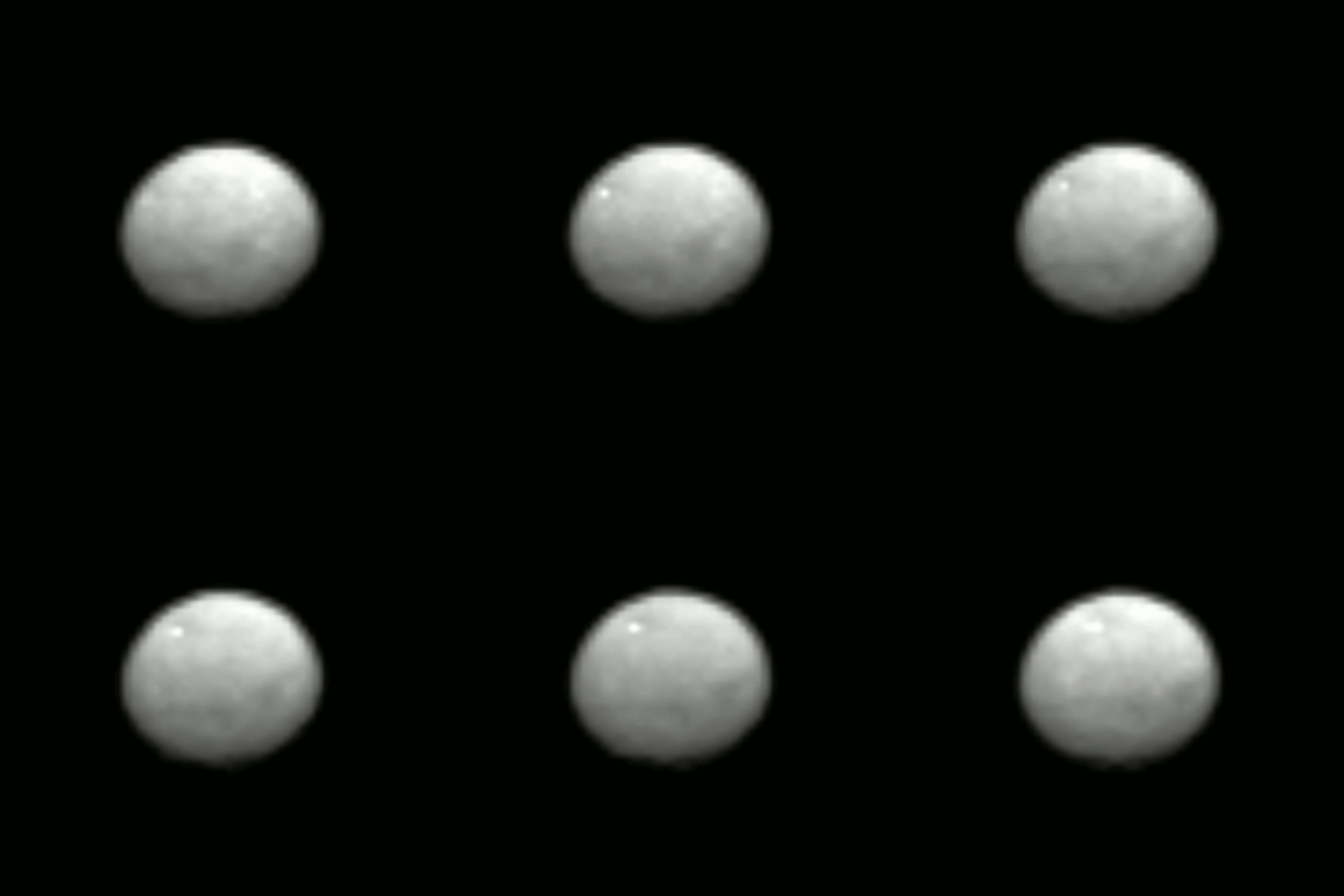
Animated picture made up of a series of pictures of Ceres
In the next few weeks, the probe should send significantly better photos of the dwarf planet. The probe will enter the orbit of Ceres on March 6 - in any case, scientists hope so. The best quality photographs of Ceres are still considered images obtained by the Hubble telescope in 2003 and 2004. Those photos that scientists have now received are about 20% worse in quality than those from Hubble. Nevertheless, in a couple of weeks, astronomers will receive the highest quality photographs of Cerrera for the entire time of observation - after all, Dawn is approaching the planet.

This is the original image of Ceres, received by scientists on January 13.
Ceres is the largest object in the asteroid belt. The diameter of the planet is 950 kilometers. Perhaps Ceres has huge deposits of water ice. Some scientists believe that under the thick ice crust there may also be a liquid ocean of water.

This is an enlarged original image of Ceres.
If the Dawn probe can successfully take a position in the orbit of Ceres, this will be the first time that an earth device has visited a dwarf planet, entering orbit. Now the team of specialists is looking forward to receiving the highest quality photographs of this space object. According to scientists, there can be many surprises.
At the moment, the Dawn probe has already transmitted 30 thousand images. Before Ceres, the probe examined the second largest object from the asteroid belt - Vestu (diameter 525 22kilometers), from 2011 to 2012.