
 March 24, 2016 at 10:45
Is a microscope necessary when connecting patchcords?
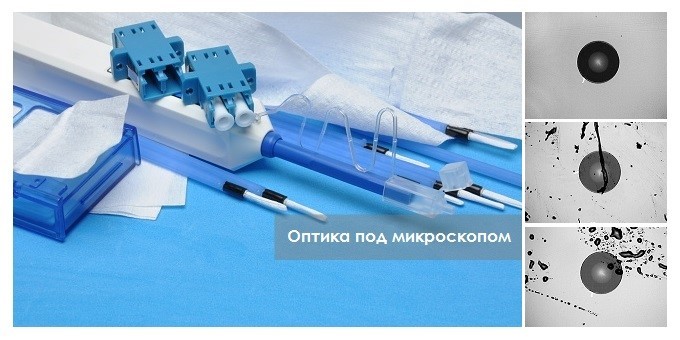
If, when working with fiber optics, you always use a microscope and specialized cleaning tools, you can not read this note. If, the need to use a microscope, when connecting "patch cords", you were puzzled - this review is for you.
When switching fiber-optic ports of active network equipment and cable systems, many, unknowingly, use tricks of working with copper-core patch cords. Is it correct? In general, the same problem is solved with those and other cords, the two data transmission channels are connected, and the procedure is similar in appearance, but, as they say, there are nuances, we will talk about them under the cut.
A typical situation: the connection of two fiber-optic ports was in doubt - something does not work or is unstable. Experience in working with electrical circuits encourages “making contact”, disconnecting and connecting several times, it may be possible to quickly get away from the “routine” and get involved in a “more interesting and important” business. But if this approach often worked with electrical contacts, then in optical connections, these movements can only worsen the situation, or even lead to serious damage in the area of the connection of the waveguides.
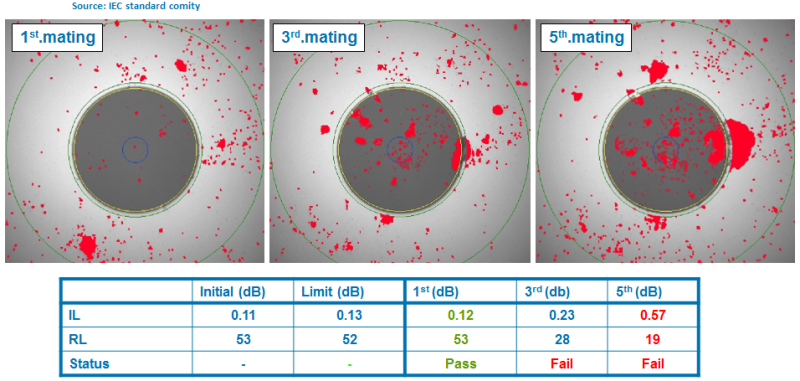
In most cases, the deterioration of the parameters of the VO compound causes clogging of the contact zone, as well as oxidation (clogging) of the electrical contact. But unlike the electro-contact, where during the switching, the galvanic contact zone can be cleaned of the oxidation (clogging) film, with several distortions of the optical compound, the contamination is shifted to the center of the waveguide.
I can not believe it - see pictures:
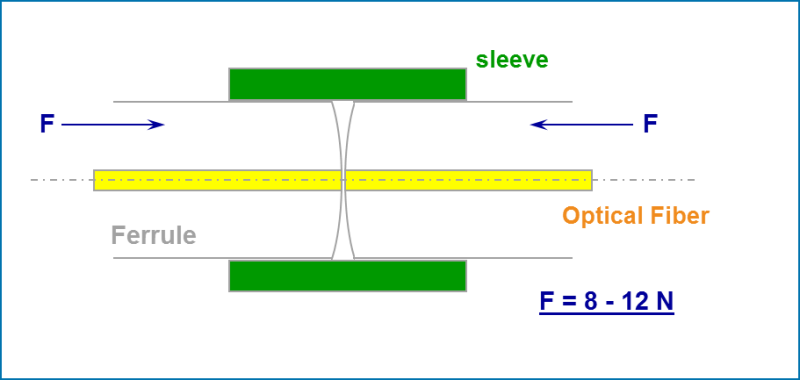
In VO connections, which, most often, now, IT specialists have to work with, as in electrical contacts, have physical contact. So, in an LC-LC, MPO-MPO or SC-SC fiber-optic connection, two quartz glass waveguides (as fragile as the glass with which we deal in everyday life) are pressed against each other, with a force of approximately 10 N ( 1kg). Moreover, the contact spot is very small, less than 125 microns. And if, when connected, something harder or as hard as glass gets into the contact zone, then damage is inevitable.
For cleaning optical compounds, more and more often lately, we are aggressively offered to use expensive special cleaning products - “What, again, marketing? What is the bad old trick: I rubbed the connector on my shirt and you're done, did it work before? ”
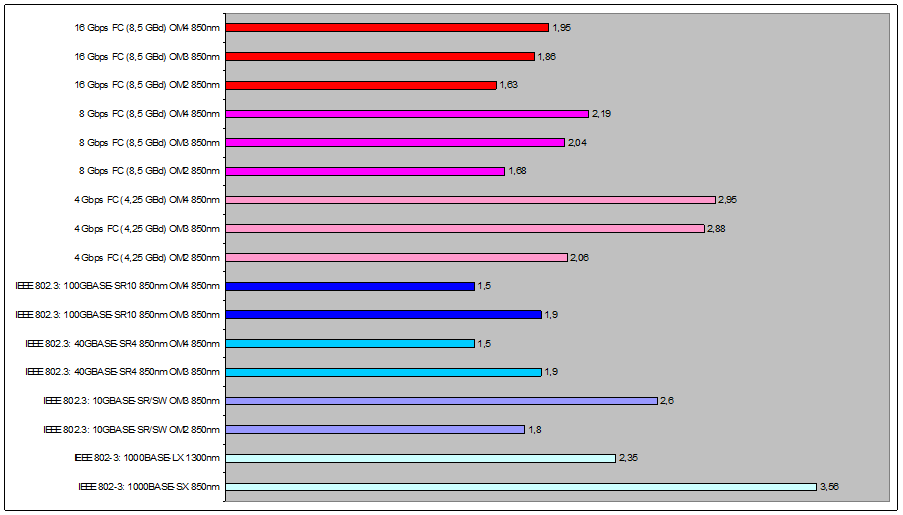
Previously, when Enterprise Networks mainly used Fast Ethernet in VO lines, application loss budgets for VO channels were quite large (loss budget is the maximum part of the transmitter signal, after which the application will stop working stably), for example 11dB for 100BASE- FX, and, accordingly, VO channels were less sensitive to contamination. The requirements of the applications we use today are much tougher. A simple touch with a “clean” hand immediately causes contamination of the end of the connector and signal loss in the channel can go beyond the budget of losses of the working application!
The figure below shows the loss budgets of the most frequently used applications in Enterprise Networks, DC (values are in dB):
How to properly inspect and switch fiber-optic connections is described in standards IEC 61300-3-35, ISO / IEC 14763-3 . Briefly, the standards propose connecting VO connectors only immediately after a positive visual inspection of both VO connectors . If necessary, during visual inspection, the standard suggests the use of specialized cleaning products, and the latter, of course, should be dry cleaned.
Without a microscope, a person cannot visually assess the state of the surface of the VO connector, so the above standard suggests using an optical or video microscope for inspection with a magnification of at least 100x.
In order to be able to always act in accordance with the requirements of the standard, it is necessary to have a 200x or 400x video microscope and a set of adapter adapters necessary for it. Only a video microscope allows you to look into the VO adapter of the patch panel, into the adapter of the cassette, the pre-determined solution into the transceiver of active equipment. A video microscope minimizes the likelihood of hazardous laser radiation entering the human retina during the inspection of connectors. A video microscope allows you to quickly capture what he sees in a photograph and save it in a file. At the same time, a video microscope is the most expensive tool necessary for inspecting VO connectors. Leading manufacturers of video microscopes: EXFO, JDSU, FLUKE, Anritsu.
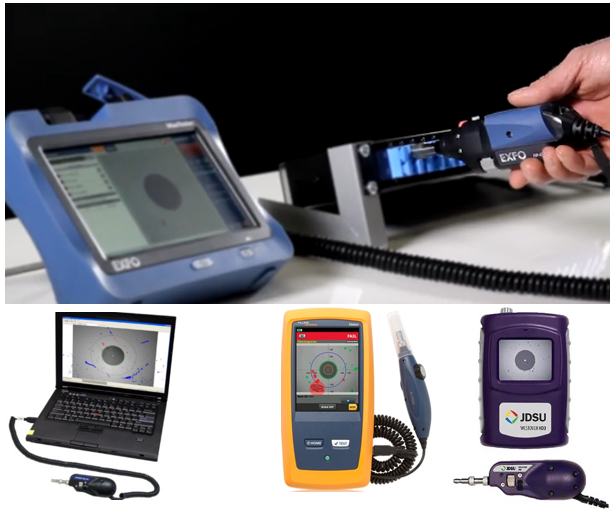
The video microscope can be connected to a USB port on a computer or to a smartphone.
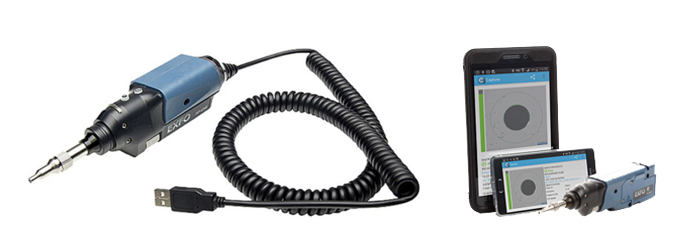
Follow the link below to watch a fun video clip from EXFO showing their new video microscope with wireless image transfer to a smartphone:
www.exfo.com/library/sales-marketing-resources/product-demos-interviews/bu3-fip-435b -wireless-probe-demo
Specialized software automatically analyzes the image of the state of the surface and gives a conclusion in accordance with the requirements of IEC 61300-3-35.
An optical microscope 200x or 400x (100x does not allow you to see everything you need) is much cheaper than a video microscope, it allows you to see smaller details, it is more compact and easy to handle, it solves the majority of inspection tasks. Therefore, it must be used during the installation of VO systems. But, unfortunately, the optical microscope does not allow you to see the VO connector in the adapter, in the adapter of the cartridge of the pre-determined solution, in the transceiver of active equipment, with it you will not be able to analyze the state of the optical ports of the test devices (LSPM, OTDR). Optical microscopes are produced, along with the above companies, manufacturers of components for building structured cabling systems: COMMSCOPE, TE Connectivity, Panduit, SIMON, R & M ...
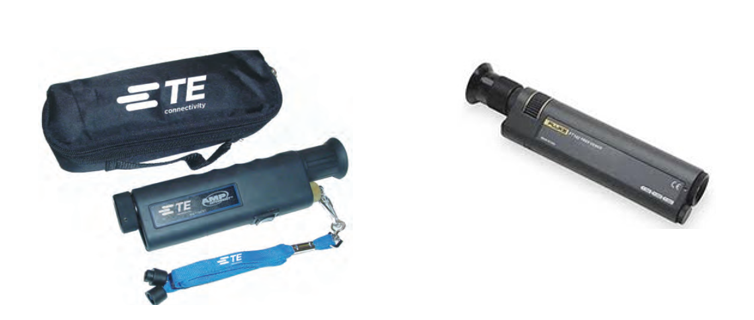
Almost all optical microscopes use the main direct illumination mode through the prism of a perpendicularly inspected surface. Some manufacturers offer another backlight mode, (the backlight goes from the side at an angle to the inspected surface). This mode is usually optional. To make full use of the capabilities of an optical microscope, experts suggest using three inspection approaches:
- in direct backlight mode, without backlight in the line at the other end
- in side light mode, without backlight in the line at the other end
- in direct backlight mode, with backlight in the line at the other end
Using the link below, you can see more detailed information on this issue:
www.thefoa.org/tech/ref/testing/test/scope.html
So, only after inspection with a microscope we can be completely sure that we connect really clean and not damaged IN connectors.
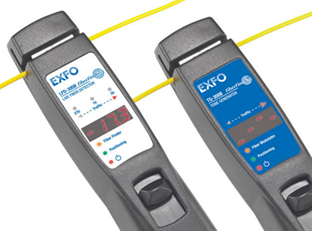
If you have not decided yet to purchase a video microscope and work in an active VO network with an optical microscope, another tool, the identifier of the active fiber, will not be superfluous. The fact is that an optical microscope, used mainly for mounting, is not always equipped with a filter that is protective for the eye (so as not to increase the cost). The active fiber identifier is connected, like a clothespin, to a thin cable of a half-cord or connecting cord and allows you to see the presence of a signal dangerous to the human eye, which the eye itself cannot see. Such a device can make it possible to estimate approximately the power level and the direction of the optical signal in the fiber.
Using a microscope and trying to clean a contaminated connector using improvised tools, I think you will quickly see that it is not as easy as it seemed. After the kitchen napkins, a small pile is necessarily present, when moistened, they become sap. Wet sanitary napkins may not leave a pile, but you can only guess what they are soaked with ... So what kind of special cleaning products are we offering?
Specialized cleaning products / tools solve a number of problems:
- get rid of pollution as quickly and efficiently as possible;
- minimize the likelihood of damage to the components during cleaning. (The more approaches, when trying to clean the surface, the higher the probability of scratching it. If you have to remove the VO connector from the adapter to clean it, there is a chance to break or create a macrobend in the fibers of the half-cords);
- cleaning of VO connectors, which, in principle, cannot be removed from the adapter (pre-terminated solution cassette, port of active equipment).
Cleaning tools in which the cleaning element is located in a closed plastic case have long been established on the market. Thanks to the closed cartridge of automatic cleaners, the cleaning element, lint-free thread or fabric tape always remains clean and each new cleaning is carried out really clean, not yet touched by its part, the thread / tape is each time rewound a step from reel to reel and all this happens during the time of one simple movement for a person.
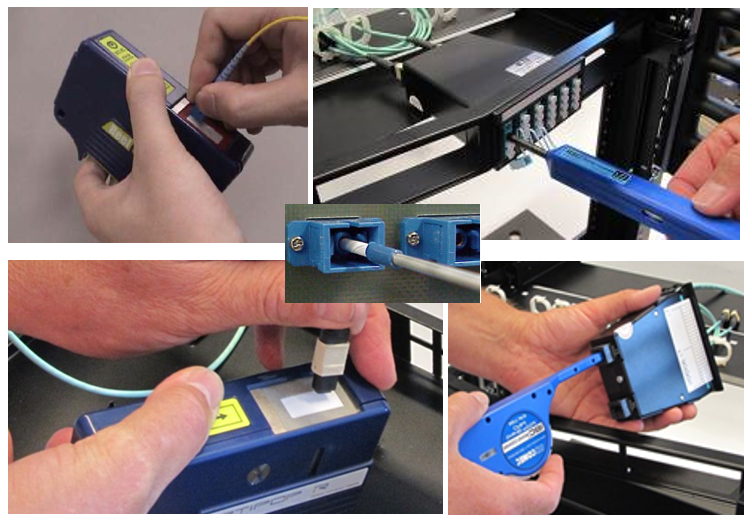
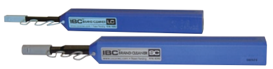 | IBC automatic optical connectors cleaners - for cleaning VO connectors installed in the panel adapter, cassettes of the pre-determined solution or in the transceiver of active equipment or the port for connecting test devices (LSPM, OTDR). Also, it can be used to clean unconnected VO connectors. In the photo, a tool for VO connectors with a ferrule of 2.5 mm and 1.25 mm. Allows you to perform more than 500 cleanings. |
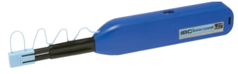 | IBC cleaner - for cleaning two LC duplex fibers at once, it can be interesting for large-scale switching and will speed up the cleaning process. |
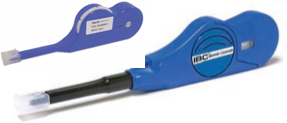 | IBC cleaner - for cleaning multi-fiber VO of MPO connectors: in a pre-terminated cassette adapter, in active equipment, as well as trunk cable connectors and MPO-MPO connecting cords. Manufacturers of pre-installed solutions with MPO connectors require you to use this tool during installation. |
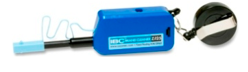 | IBC cleaner - with a shortened case, can be indispensable in hard-to-reach places, but the resource is lower than that of a conventional one. |
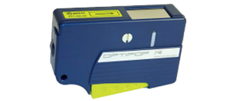 | Closed cartridge with a rotatable replaceable cartridge - for cleaning the BO connectors of all types, but only not fixed in the adapter. Replacement cartridges can be ordered separately. This tool is most effective for VO connectors, because, unlike IBC cleaner, it allows you to completely clean the entire surface of the end of the ferula, not only the contact area. |
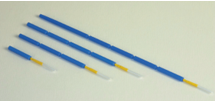 | Cleaning sticks 1.25mm and 2.5mm - there are different. Most of them are designed primarily for cleaning the guide inside the BO adapter and are not very effective for cleaning the end face of the BO connector installed in the adapter. It is productive to use sticks together with a cylinder of compressed air, since the stick only cleans the surface of the guide sleeve along which the ferul glides. |
 | Cylinder with purified compressed air (or special gas) - for cleaning the working area of the adapter from large particles of contamination. Only for the cylinder is it possible to clean the section of the adapter guide sleeve and other cavities where contamination can accumulate. The balloon can also be used, if necessary, to moisten dry products. Using cylinders that are not specialized for VO, you risk seriously clogging the adapter and VO connector, because any impurities may be contained in untreated air, and their concentration increases greatly when compressed and transferred to a liquid state in the cylinder. |
 | Various open-type lint-free napkins (without a closed drawer) - less cost, but clog faster |
 | Wet wipes (impregnated with isopropyl or other special composition) - when dry cleaning can not cope. One of the most affordable cleaning products. Each napkin in a separate sealed package, which is very convenient, each guaranteed to be clean even in the most severe conditions. Although the first purpose of these napkins is installation work, they are also used for maintenance. |
| Wet wipes with special active impregnation - when dry products and isopropyl can not cope. | |
| Someone, to moisturize the above dry products, instead of isopropyl, uses 96% ethyl alcohol, but it is not always clean and there is water in it. |
There are also portable automated cleaning systems on the market. Such a system can be in demand when testing or servicing objects with a large number of VO connections. By reference, you can see a description of the automated non-contact CleanBlast cleaning system from JDSU: www.fiberoptic.com/mmfiberoptic/PDFs/CleanBlast%20Benchtop%20Unit.pdf
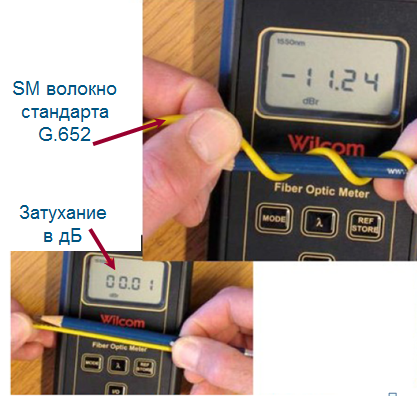
All this time we talked about how to keep the VO connectors clean, but the VO connecting cord is also a cable (it also looks a bit like a copper core). Quartz waveguides are located under the sheath and other protective elements of the fiber optic cable design. And despite the fact that we emphasized the fragility and vulnerability of the surface of the end face of a quartz waveguide, the fibers in the design of the VO cable are well protected and allow working with the VO cable of the connecting cords almost as well as with the cable of copper-core cords. But, with the only difference that the unacceptable deformation of copper-core cords, which also leads to a loss of line parameters, is not so noticeable and does not lead to a complete break in the transmission line, as can happen with VO cords. When bending the VO cable of the cord to a radius less than Losses increase in the place of bending (part of the signal goes beyond the waveguide), with a further decrease in the bending radius, losses increase until the fiber breaks (like straws). It is characteristic that if, in the process of accidental deformation, the fiber did not reach the critical point of breaking, restoring the bending radius of the cable, we will restore the loss at the point of bending of the fiber. There are cables, both copper-core and fiber-optic, whose sheath “remembers” the violation, whitens in the place where the minimum bending radius was exceeded. But, so far, such cables can not be seen often in our projects, therefore, damage to the cord fiber can be invisible during external inspection. in the process of accidental deformation, the fiber did not reach the critical point of breaking, restoring the bending radius of the cable, we will restore the loss at the point of bending of the fiber. There are cables, both copper-core and fiber-optic, whose sheath “remembers” the violation, whitens in the place where the minimum bending radius was exceeded. But, so far, such cables can not be seen often in our projects, therefore, damage to the cord fiber can be invisible during external inspection. in the process of accidental deformation, the fiber did not reach the critical point of breaking, restoring the bending radius of the cable, we will restore the loss at the point of bending of the fiber. There are cables, both copper-core and fiber-optic, whose sheath “remembers” the violation, whitens in the place where the minimum bending radius was exceeded. But, so far, such cables can not be seen often in our projects, therefore, damage to the cord fiber can be invisible during external inspection.
From the foregoing, we can conclude that the fiber of the connecting cord, the bending radius of which is not currently broken, can usually have two states: whole or broken. Moreover, the losses in the fiber of the short VO cord, without violating the bending radius, are insignificant compared with the losses at its connectors.
You can check the integrity of the fiber of a short cord with any flashlight. And you can use a special "flashlight" VFL (Visual Fault Locator) for this. This is a tool with a special laser source, the spectrum of which is seen by the human eye, 650nm (635-670) red. And of course, the power of this source is normalized by a level safe for the eye (as a rule, devices with a Class 2 laser with a power of 1mW or slightly higher are used). Nevertheless, they do not look directly at the signal of such a source, they look at the light scattered or reflected from some surface. Using such a tool, you can not only check the integrity of the fiber of the cable in the cord, but also see the place of damage to the fiberunder the undamaged cable sheath. The scattered light of such a laser source, at the breaking point, will break through the Kevlar protective buffer and the cable sheath.
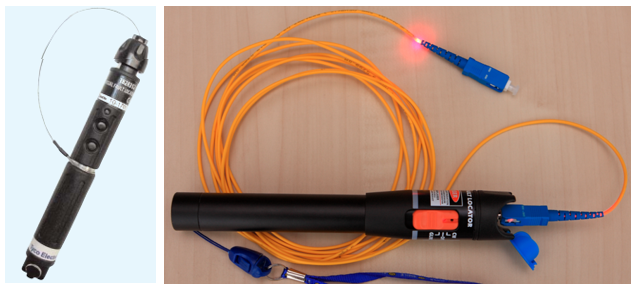
VFL will allow you to analyze whether the fiber is whole, whether the half-cords are correctly laid in the VO panel, whether there are macro-bends (small sections of the fiber where the fiber is deformed by the external environment, for example, a pressed fiber). On semi-cords with a white buffer, macro-bends are clearly visible, violation of the radius when laying. The VFL signal, unlike a conventional flashlight, passes, without loss, a VO line of much greater length and you, with its help, can already confidently check the trace or integrity of the fibers of the entire VO channel, from port to port of active equipment, including all intermediate connections. When acquiring VFL, you should not make a choice according to the rule: "the more powerful the better." The main task of this device is a visual analysis of nearby, nearby events (where, using an OTDR, it can be more difficult and less convenient to see damage), and not the "enlightenment" of long highways. There are VFLs on the market with a capacity of 10mW and 20mW, with marketing inscriptions 10km, 20km. The radiation, with a wavelength of 650nm, decays rather quickly (about 7.5 dB / km in the G.652 fiber) and it will be difficult to see something after 10km from a 10mW source. But, by chance, looking directly at the signal, which causes slight dizziness, if you just looked at its reflection from the wall in the room, is not pleasant enough.
There may be situations when the VO connectors look good in the microscope and the fiber is not damaged, and the connection cord raises questions:
- For example, if you, by mistake, try to connect the SM cord instead of the MM cord. These cords may have the same and compatible form of VO connectors, only the color coding is different. And most importantly, these cords have different types of fibers and with such a connection, the connecting cord will be a place of huge losses.
- If you connect a cord with the same form of connectors but with OM2 fiber to the BO line with OM3 or OM4 fiber, be prepared for a slight increase in losses (a larger measure because the accuracy of grinding and control of OM3 / OM4 is higher than that of OM2 cords )
- The case when you decided to use a VO connecting cord from the manufacturer “CHEAPER”: the fiber is whole, the ends are clean, but you have no way to evaluate the geometry of the ends of the VO connectors, the displacement of the fiber relative to the center of the ferul, this is done only at the factory and only serious manufacturers. To understand this situation, you will have to analyze the parameters IL (Insertion Loss) and RL (Return Loss), they are indicated on the packaging for each connector. And you will have the opportunity to find out that the RL parameter, for the application to work, is as important as the IL, and that Ethernet stops working stably if the Total RL of the channel is less than 12 dB. Another example is when a clean, with a whole fiber, connecting cord from the manufacturer mentioned above works fine, but for some reason, sometimes it loses connection, as if someone didn’t specifically insert the VO connector until it clicks (seen with VO type SC connectors). This situation can often occur with fluctuations in ambient temperature.
But even when using high-quality components in VO channels, there are situations that require more attention. If you checked the tracing, fiber integrity and cleanliness of the connectors, but there are still doubts about the BO line, it is worth measuring IL (Insertion Loss) the actual signal loss in the BO channel from port to port of active equipment, compare them with the estimated loss budget for the BO channel and with the loss budget of the active equipment application that you are currently connecting. To do this, you need a test signal source with the same wavelength as the active equipment and test connection cords. The kit of such a meter is called LSPM (Light Source Power Meter). If using LSPM you have verified that the VO channel is not working, to localize and eliminate the cause,
SCS department of the MUK group of companies
All questions about SCS: scs@muk.ua
Distribution of SCS solutions in Ukraine and the CIS countries
MUK-Service - all types of IT repair: warranty, non-warranty repair, sale of spare parts, contract service
UPD by comments: The author of the article emphasizes that the channels of SCS and DPC highways are most sensitive to pollution, since the applications that are used today have a very small loss budget. The same will happen with the single-mode telecom trunk if the insertion loss of the channel is close to the loss budget of the application that is used for reception / transmission. For field conditions, the military uses non-contact VO connectors, which can be "rinsed in a puddle" and everything will work, but the note does not talk about them.
The author tried, within the framework of a concise article, to share systematized information about the intricacies of servicing VO channels of SCS, which not everyone has time to deal with, but somehow have to do work. There are no sensational discoveries in the article, just to deal with these simple things, you need to spend time, go through a series of mistakes, sometimes expensive mistakes.
Once, one of the partners of the installers asked the question: “Is it possible to replace the connection port ferrule with OTDR?”. The device, worth 20kUSD, was "turned into brick with a flick of the wrist" by mistake or due to inexperience. Another case: at one of the data center installation sites, something did not work for the installer to work with OTDR. As it turned out, the installer used OTDR for many years without a microscope, and he did not think that it was necessary to strictly monitor the cleanliness of the connection port. This installer was very surprised when he saw the port status of his OTDR under a video microscope and when he understood why his OTDR had lost almost half of its dynamic range. But it was already too late to clean something, the surface of the ferula was covered with shells and scratches. The transmitter port of the active equipment has the same physical contact,
It is quite natural that the ubiquitous annoying marketing has already developed protective reflexes for us: “Once they write about something, it means they want to“ vparize ”something. But the publication’s task is not to sell video microscopes and cleaning products in bulk, but that we (scs@muk.ua) can help solve organization design and competent support for the cable infrastructure of an office facility, industrial enterprise, or data center, based on the products of SCS market leaders.