December 11, 2015 at 19:11
Learn more: AudioCodes Multimedia Gateway
Good afternoon.
In this article, we will begin a session of several online lectures and articles on a separate line of AudioCodes equipment - universal multimedia gateways that are positioned for individuals and small businesses. This is the same segment called SOHO. In this article, we will present an overview and information about the line of devices, the history of its development and a brief description of the functionality. We are talking about the universal CPE AudioCodes MediaPack 26x series (MP26x).
The evolution of the development of this line is more than 8 years old. It all started with the MP20x series of devices, which were a simple ATA (Analog Telephone Adapter) with a simple built-in router. There were several models, most of them are no longer available. However, MP201, MP202, MP204 devices with 1, 2 and 4 FXS ports are still manufactured and sold in large volumes, respectively.
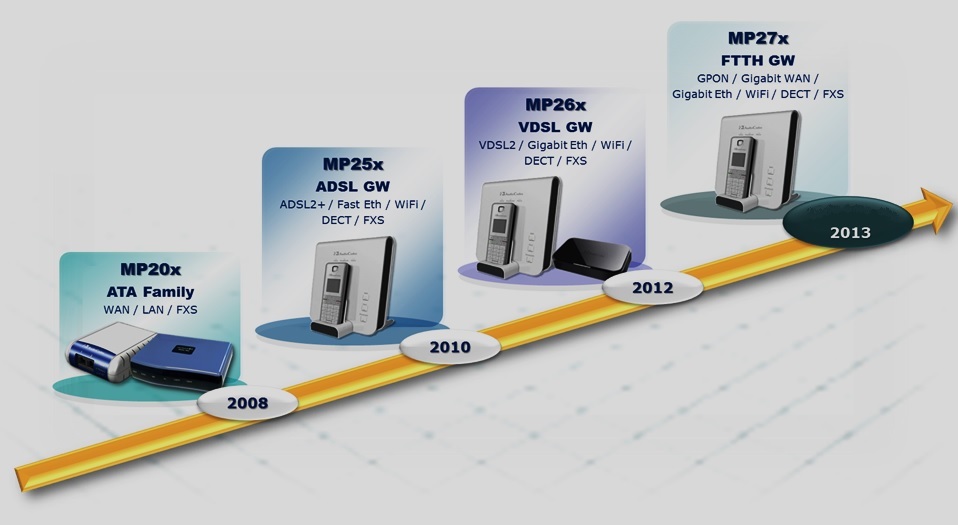
Based on these devices, in 2010 the updated CPE line - MP252 was created, which was subsequently smoothly and discreetly replaced with MP26x. Currently, the MP26x line of devices is the leading device and CPE in the line for connecting subscribers from among individuals and is positioned mainly for the operator market. MP264 equipment is already sold through regular retail chains.
AudioCodes MediaPack ™ Series 26x, 272 Series is an advanced multifunctional, multimedia home or office gateway for multiservice networks. It supports connection to Ethernet networks and broadband access networks. The gateway has a built-in modem with support for ADSL / ADSL2 + / VDSL, two types of wireless networks are supported - WiFi and DECT. Pluggable DECT handsets (up to 5 handsets) support the transmission of high-quality HD voice over IP (High Definition VoIP), in addition, you can use the power battery, which will provide the gateway with 3-4 hours of operation in case of power failure. The presence of USB ports provides additional benefits for home and office use. The MP-26x, MP-272 devices are a true all-in-one device for working in the Triple Play multiservice network or in a small office.
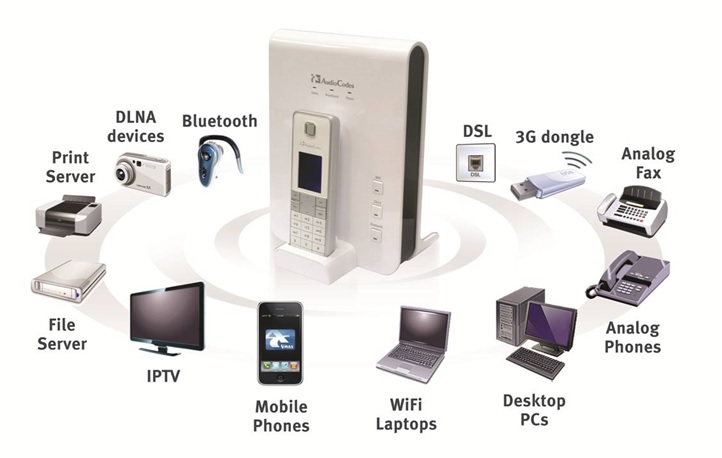
Comparative characteristics of existing models will be made according to several parameters - WAN interfaces, LAN interfaces, their speeds, the availability of built-in Wi-Fi, DECT and other voice functions.
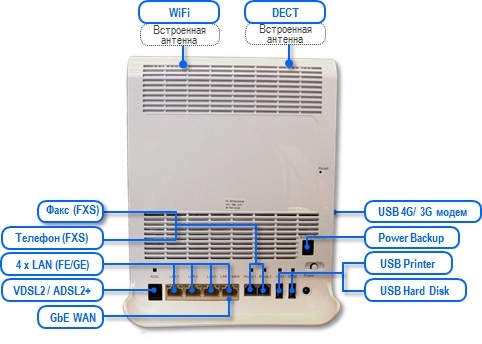
Let's start with the description of the interfaces. The back panel of the device is shown in the following figure:
Any device modification contains several mandatory components:
• 4 LAN ports - allow you to connect all kinds of IP devices, such as television set-top boxes, desktop computers or various other devices that require an Ethernet connection.
• 4th LAN port works in combined mode - either LAN or WAN Ethernet, depending on configuration
• Built-in WiFi access point
• 2 or 3 USB ports - creating file or print servers, connecting 3G / 4G modems
• 2 FXS ports - for connecting analog phones or fax machines of any kind
• ADSL / VSDL port (built-in ADSL / ADSL2 + / VDSL modem)
Advanced models additionally have The following is available:
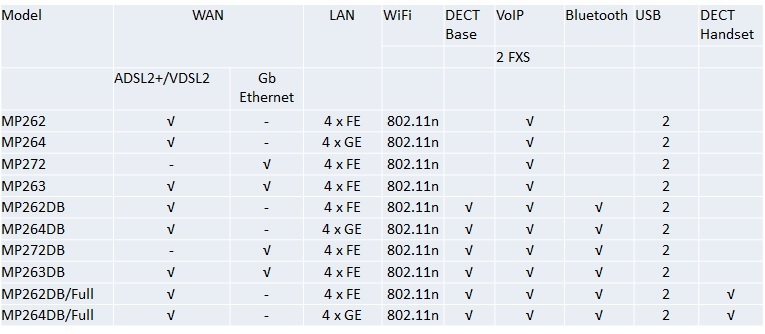
• Built-in DECT base (support up to 5 handsets)
• Bluetooth support for synchronizing address books of mobile phones and built-in DECT base
The MP272 model does not have a built-in ADSL / ADSL2 + / VDSL modem, but instead it has a dedicated WAN GE port.
The summary comparison table in terms of interfaces looks like this:
There are also kits where one DECT tube is already included. In this regard, it must be noted that third-party DECT tubes are also supported, but these tubes must necessarily support the GAP protocol. Otherwise, registering such a handset on the DECT base of MP26x / 272 will fail.
The functionality of the devices is common to all models. We single out the main, but not all, moments.
WAN access
• ADSL support: ADSL (ITU-TG.992.1, AnnexA, B), ADSL2 (ITU-TG.992.3 Annex A, B, I, J, L, M), ADSL2 + (ITU-TG.992.5 AnnexA, B , I, J, M), Multiple VC / PPP connections, PVC Scanning
• Support for VDLS - VDSL2 30a profile, support for VDSL vectoring (G.993.5)
• Support for ETH WAN - 10/100 / 1000Mbps Ethernet ports
• 3G / 4G support - all modern connection types, RAS (OPTION driver), NCM (CDC-NCM driver), as well as previous versions of these drivers (depending on the modem)
• Dual WAN - support for two types of connection simultaneously (xDSL + LTE, Ethernet + LTE) with traffic balancing
Data transfer protocols and security
• IPv4, PPPoE, PPPoA, PPTP, L2TP, DNS proxy, Dynamic DNS, DHCP Client - Server and Proxy, IP Multicast (IGMP proxy, snooping), NAT - RFC3022, Application Layer Gateway (ALG), Port Triggering, UPnP auto-configuration and port-forwarding (IGD)
• IEEE 802.1p / Q (QoS & VLAN Tagging), ToS / Diffserv, QoS Traffic prioritization and shaping
• SPI Firewall, URL filtering, advanced access control, Denial of Service attack prevention, encrypted configuration file support, Web Authentication, HTTPS provisioning, IPSec
• SIP security: SIP over TLS (SIPS)
support Wireless LAN support
• Integrated 802.11b / g / n 2x2 WiFi Access Point, Multiple SSID support, up to 300Mbps
• 802.1x authentication, WPA, WPA2, WPA / WEP mixed mode, TKIP Encryption, MAC Filtering, WPS, Web authentication
• Support for various SSIDs for WiFi networks (up to 4 SSID)
Voice functionality
• Signal protocol - SIP over TCP / UDP - RFC 3261
• Full compatibility with all leading SIP servers and softswitches
• Media traffic processing
- support for G.711μ / a-law, G.729A / B, G.723.1, G.722 (for HD VoIP), G722.2 (WB-AMR),
- Analog Signaling Caller ID (Bellcore, ETSI, DTMF) ,
- MWI DTMF detection and generation, in-band and out-of-band
- generation of customized tones
- T.38 Fax Relay, VBD (Voice Band Data), Bypass
• Support for DECT GAP and CAT-iq 2.0 on models with DECT ( MP-2xx-DB)
• Support for DECT upgrades for compatibility with future versions of CAT-iq
• Flexible configuration and individual SIP settings for DECT handsets
• Built-in “auto attendant” functionality on the main line for small
Micro PBX offices
• Support for extension numbers, 5 DECT subscribers, 2 FXS a onenta
• Services: Call Waiting, Call Hold, Call Transfer, Call Forward, Hot Line, 3-Way Conference with local mixing, Hunt Group, Do Not Disturb, Flexible dialing plan,
• Ability to connect up to 7 simultaneous SIP lines with independent SIP connection parameters (login, password)
• Ability to process up to 4 simultaneous calls
• Independent switching of internal calls between all subscribers connected to the gateway (intercom)
More detailed information on the line and functionality can be found in the brief description in Russian, which is here . I also recommend using the special section of our official website: www.audiocodes.com/mp26x
Separately, it is worth mentioning the quality of telephone communications when using the MP26x. It is important to talk about two aspects. First, the ability to use a wide range of codecs, including the AMR codec. This codec is supported on the device and its use gives an undeniable advantage in quality. Secondly, the device’s functionality includes the ability to use the innovative ABE (Artificial Bandwidth Extension) technique - the development of AudioCodes. This feature of the equipment is to recreate a wideband voice signal from a narrowband one (the bandwidth of the voice signal is expanded by mathematical methods).

This improves speech sensitivity. The subscriber hears a voice in HD quality even when making calls to a standard analog line. Therefore, not only the DECT subscriber, but also the FXS subscriber enjoys higher quality speech.
Now let's talk a little about the capabilities of devices in terms of management and diagnostics. Almost all the currently existing management capabilities are supported:
1. Built-in Russified web server for configuration and management. This is the most affordable and most common method for managing and configuring devices.
2. Support of protocols TR-069, TR-104, TR-111. For example, you can use free OpenACS as an ACS server for small projects.
3. Support for auto-configuration modes using DHCP - options 66, 67
4. Ability to configure through the command line. This is not always convenient, and applies more to those users who have sufficient skills and knowledge of such management methods
5. Using configuration files. Moreover, we note that the configuration file is a text file (nonetheless, the passwords are stored in it in encrypted form). In addition, the configuration file can be encrypted and downloaded to the device in encrypted form. CPE decrypts such a file on its own.
6. Support for special functionality for remote provisioning in case of impossibility of access to the device using mechanisms using the HTTP protocol (web, TR-69, etc.). This is more relevant to the topic of mass provisioning of devices in cases where the CPE is located deep in the user network behind NAT or behind multiple NATs and when it is impossible to manage it via the web interface.
As regards diagnostics and trableshooting, we highlight the following points:
1. Advanced trableshooting and diagnosing features - built-in tcpdump, syslog and packet recording (information directly from the DSP processor)
2. BroadSoft PacketSmart agent for voice quality and QoE monitoring. This mechanism applies to those operators and their subscribers who use PacketSmart solutions.
3. Functionality support LST (Local Support and Troubleshooting) - automatic troubleshooting and user alerts (interception of web requests and voice alerts when trying to call) - Russified. This functionality allows you to inform the user about the most common problems. For example, to notify about a disconnected cable or about the lack of SIP registration on a proxy server. It immediately becomes clear where and with what primary information to look for connection problems.
In one of the following articles, we will talk in more detail about how to use the mechanisms of diagnosis and troubleshoot.
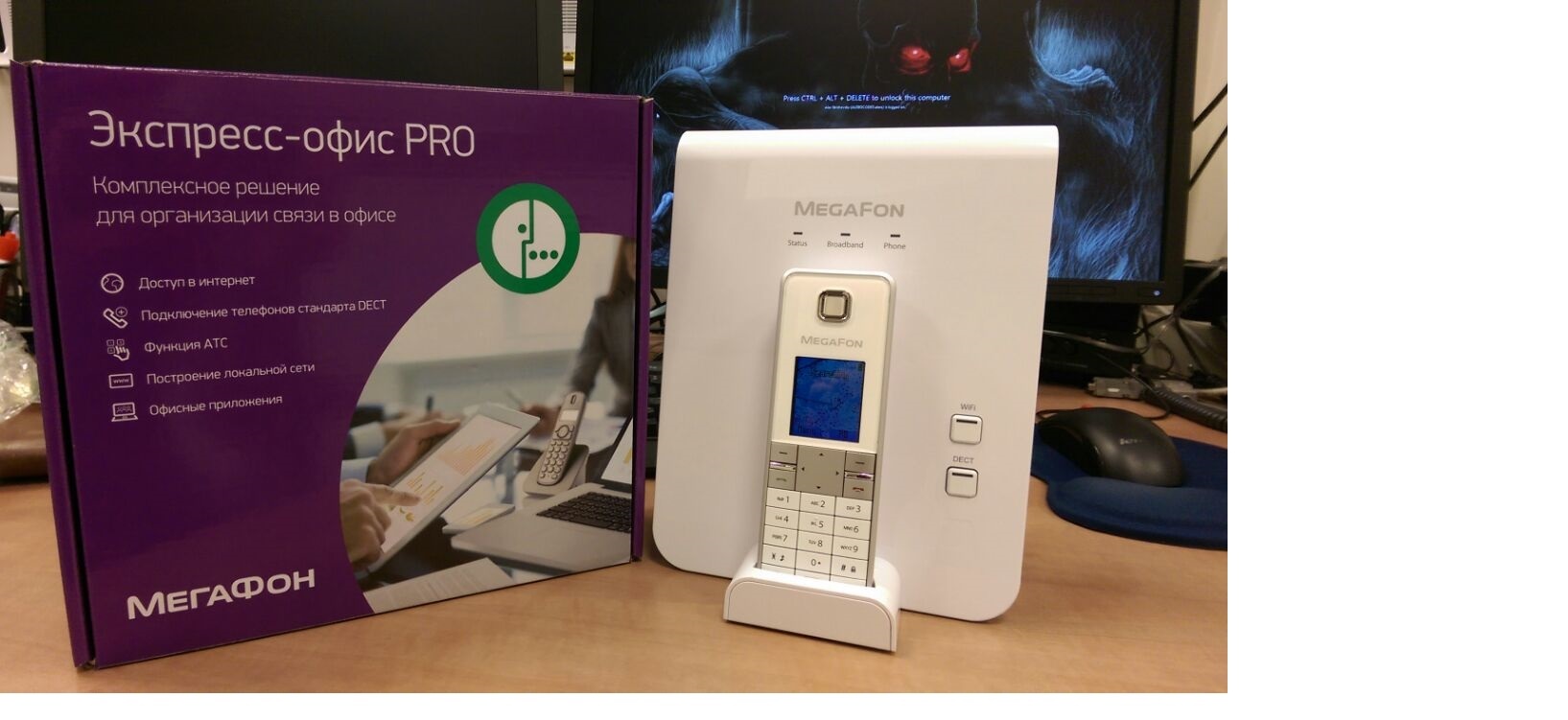
Finally, we say that in the Russian Federation there are a lot of examples of projects where one or another model from this CPE line is used. The number of connected devices on the networks of various telecom operators, both federal and regional, amounts to tens of thousands. However, I would like to separately note one of such projects. It was launched into commercial operation throughout Russia in May 2015 together with Megafon. One of the devices that is used when connecting to the Express Office service from Megafon is MP272D. And here you can find a brief description and positioning of the device, as Megafon himself sees it.
Express Office PRO is a slightly modified model MP272DB, with customized firmware and without Bluetooth. The device is branded for Megafon and has a special name - Megafon R2. Here is the whole kit and device.
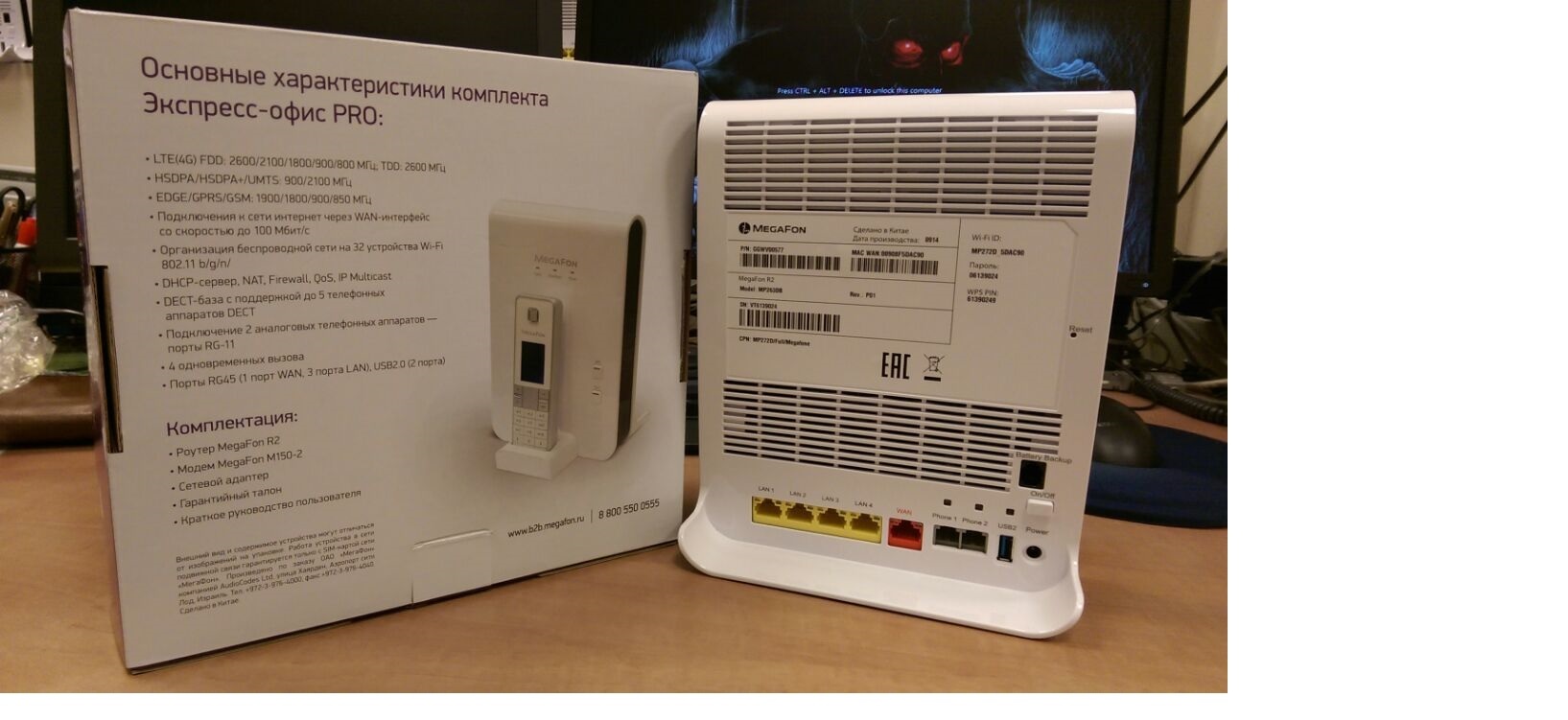
The kit includes a 4G modem from Megaphone. And being connected to the USB port, it acts as the main or auxiliary (along with WAN ETH) uplink. Using 4G makes it possible to deploy a fully wireless small office. Here is a short video about the product features:
We wish you successful connections. Enjoy excellent communication quality when using MP26x devices!
In this article, we will begin a session of several online lectures and articles on a separate line of AudioCodes equipment - universal multimedia gateways that are positioned for individuals and small businesses. This is the same segment called SOHO. In this article, we will present an overview and information about the line of devices, the history of its development and a brief description of the functionality. We are talking about the universal CPE AudioCodes MediaPack 26x series (MP26x).
The evolution of the development of this line is more than 8 years old. It all started with the MP20x series of devices, which were a simple ATA (Analog Telephone Adapter) with a simple built-in router. There were several models, most of them are no longer available. However, MP201, MP202, MP204 devices with 1, 2 and 4 FXS ports are still manufactured and sold in large volumes, respectively.
Based on these devices, in 2010 the updated CPE line - MP252 was created, which was subsequently smoothly and discreetly replaced with MP26x. Currently, the MP26x line of devices is the leading device and CPE in the line for connecting subscribers from among individuals and is positioned mainly for the operator market. MP264 equipment is already sold through regular retail chains.
AudioCodes MediaPack ™ Series 26x, 272 Series is an advanced multifunctional, multimedia home or office gateway for multiservice networks. It supports connection to Ethernet networks and broadband access networks. The gateway has a built-in modem with support for ADSL / ADSL2 + / VDSL, two types of wireless networks are supported - WiFi and DECT. Pluggable DECT handsets (up to 5 handsets) support the transmission of high-quality HD voice over IP (High Definition VoIP), in addition, you can use the power battery, which will provide the gateway with 3-4 hours of operation in case of power failure. The presence of USB ports provides additional benefits for home and office use. The MP-26x, MP-272 devices are a true all-in-one device for working in the Triple Play multiservice network or in a small office.
Comparative characteristics of existing models will be made according to several parameters - WAN interfaces, LAN interfaces, their speeds, the availability of built-in Wi-Fi, DECT and other voice functions.
Let's start with the description of the interfaces. The back panel of the device is shown in the following figure:
Any device modification contains several mandatory components:
• 4 LAN ports - allow you to connect all kinds of IP devices, such as television set-top boxes, desktop computers or various other devices that require an Ethernet connection.
• 4th LAN port works in combined mode - either LAN or WAN Ethernet, depending on configuration
• Built-in WiFi access point
• 2 or 3 USB ports - creating file or print servers, connecting 3G / 4G modems
• 2 FXS ports - for connecting analog phones or fax machines of any kind
• ADSL / VSDL port (built-in ADSL / ADSL2 + / VDSL modem)
Advanced models additionally have The following is available:
• Built-in DECT base (support up to 5 handsets)
• Bluetooth support for synchronizing address books of mobile phones and built-in DECT base
The MP272 model does not have a built-in ADSL / ADSL2 + / VDSL modem, but instead it has a dedicated WAN GE port.
The summary comparison table in terms of interfaces looks like this:
There are also kits where one DECT tube is already included. In this regard, it must be noted that third-party DECT tubes are also supported, but these tubes must necessarily support the GAP protocol. Otherwise, registering such a handset on the DECT base of MP26x / 272 will fail.
The functionality of the devices is common to all models. We single out the main, but not all, moments.
WAN access
• ADSL support: ADSL (ITU-TG.992.1, AnnexA, B), ADSL2 (ITU-TG.992.3 Annex A, B, I, J, L, M), ADSL2 + (ITU-TG.992.5 AnnexA, B , I, J, M), Multiple VC / PPP connections, PVC Scanning
• Support for VDLS - VDSL2 30a profile, support for VDSL vectoring (G.993.5)
• Support for ETH WAN - 10/100 / 1000Mbps Ethernet ports
• 3G / 4G support - all modern connection types, RAS (OPTION driver), NCM (CDC-NCM driver), as well as previous versions of these drivers (depending on the modem)
• Dual WAN - support for two types of connection simultaneously (xDSL + LTE, Ethernet + LTE) with traffic balancing
Data transfer protocols and security
• IPv4, PPPoE, PPPoA, PPTP, L2TP, DNS proxy, Dynamic DNS, DHCP Client - Server and Proxy, IP Multicast (IGMP proxy, snooping), NAT - RFC3022, Application Layer Gateway (ALG), Port Triggering, UPnP auto-configuration and port-forwarding (IGD)
• IEEE 802.1p / Q (QoS & VLAN Tagging), ToS / Diffserv, QoS Traffic prioritization and shaping
• SPI Firewall, URL filtering, advanced access control, Denial of Service attack prevention, encrypted configuration file support, Web Authentication, HTTPS provisioning, IPSec
• SIP security: SIP over TLS (SIPS)
support Wireless LAN support
• Integrated 802.11b / g / n 2x2 WiFi Access Point, Multiple SSID support, up to 300Mbps
• 802.1x authentication, WPA, WPA2, WPA / WEP mixed mode, TKIP Encryption, MAC Filtering, WPS, Web authentication
• Support for various SSIDs for WiFi networks (up to 4 SSID)
Voice functionality
• Signal protocol - SIP over TCP / UDP - RFC 3261
• Full compatibility with all leading SIP servers and softswitches
• Media traffic processing
- support for G.711μ / a-law, G.729A / B, G.723.1, G.722 (for HD VoIP), G722.2 (WB-AMR),
- Analog Signaling Caller ID (Bellcore, ETSI, DTMF) ,
- MWI DTMF detection and generation, in-band and out-of-band
- generation of customized tones
- T.38 Fax Relay, VBD (Voice Band Data), Bypass
• Support for DECT GAP and CAT-iq 2.0 on models with DECT ( MP-2xx-DB)
• Support for DECT upgrades for compatibility with future versions of CAT-iq
• Flexible configuration and individual SIP settings for DECT handsets
• Built-in “auto attendant” functionality on the main line for small
Micro PBX offices
• Support for extension numbers, 5 DECT subscribers, 2 FXS a onenta
• Services: Call Waiting, Call Hold, Call Transfer, Call Forward, Hot Line, 3-Way Conference with local mixing, Hunt Group, Do Not Disturb, Flexible dialing plan,
• Ability to connect up to 7 simultaneous SIP lines with independent SIP connection parameters (login, password)
• Ability to process up to 4 simultaneous calls
• Independent switching of internal calls between all subscribers connected to the gateway (intercom)
More detailed information on the line and functionality can be found in the brief description in Russian, which is here . I also recommend using the special section of our official website: www.audiocodes.com/mp26x
Separately, it is worth mentioning the quality of telephone communications when using the MP26x. It is important to talk about two aspects. First, the ability to use a wide range of codecs, including the AMR codec. This codec is supported on the device and its use gives an undeniable advantage in quality. Secondly, the device’s functionality includes the ability to use the innovative ABE (Artificial Bandwidth Extension) technique - the development of AudioCodes. This feature of the equipment is to recreate a wideband voice signal from a narrowband one (the bandwidth of the voice signal is expanded by mathematical methods).
This improves speech sensitivity. The subscriber hears a voice in HD quality even when making calls to a standard analog line. Therefore, not only the DECT subscriber, but also the FXS subscriber enjoys higher quality speech.
Now let's talk a little about the capabilities of devices in terms of management and diagnostics. Almost all the currently existing management capabilities are supported:
1. Built-in Russified web server for configuration and management. This is the most affordable and most common method for managing and configuring devices.
2. Support of protocols TR-069, TR-104, TR-111. For example, you can use free OpenACS as an ACS server for small projects.
3. Support for auto-configuration modes using DHCP - options 66, 67
4. Ability to configure through the command line. This is not always convenient, and applies more to those users who have sufficient skills and knowledge of such management methods
5. Using configuration files. Moreover, we note that the configuration file is a text file (nonetheless, the passwords are stored in it in encrypted form). In addition, the configuration file can be encrypted and downloaded to the device in encrypted form. CPE decrypts such a file on its own.
6. Support for special functionality for remote provisioning in case of impossibility of access to the device using mechanisms using the HTTP protocol (web, TR-69, etc.). This is more relevant to the topic of mass provisioning of devices in cases where the CPE is located deep in the user network behind NAT or behind multiple NATs and when it is impossible to manage it via the web interface.
As regards diagnostics and trableshooting, we highlight the following points:
1. Advanced trableshooting and diagnosing features - built-in tcpdump, syslog and packet recording (information directly from the DSP processor)
2. BroadSoft PacketSmart agent for voice quality and QoE monitoring. This mechanism applies to those operators and their subscribers who use PacketSmart solutions.
3. Functionality support LST (Local Support and Troubleshooting) - automatic troubleshooting and user alerts (interception of web requests and voice alerts when trying to call) - Russified. This functionality allows you to inform the user about the most common problems. For example, to notify about a disconnected cable or about the lack of SIP registration on a proxy server. It immediately becomes clear where and with what primary information to look for connection problems.
In one of the following articles, we will talk in more detail about how to use the mechanisms of diagnosis and troubleshoot.
Finally, we say that in the Russian Federation there are a lot of examples of projects where one or another model from this CPE line is used. The number of connected devices on the networks of various telecom operators, both federal and regional, amounts to tens of thousands. However, I would like to separately note one of such projects. It was launched into commercial operation throughout Russia in May 2015 together with Megafon. One of the devices that is used when connecting to the Express Office service from Megafon is MP272D. And here you can find a brief description and positioning of the device, as Megafon himself sees it.
Express Office PRO is a slightly modified model MP272DB, with customized firmware and without Bluetooth. The device is branded for Megafon and has a special name - Megafon R2. Here is the whole kit and device.
The kit includes a 4G modem from Megaphone. And being connected to the USB port, it acts as the main or auxiliary (along with WAN ETH) uplink. Using 4G makes it possible to deploy a fully wireless small office. Here is a short video about the product features:
We wish you successful connections. Enjoy excellent communication quality when using MP26x devices!