Learn how to calculate the interplanetary habitable zone (IHZ) for space colonization. Comparison of the Solar System and TRAPPIST-1, Δv factors, radiation, resources. Models for developers.
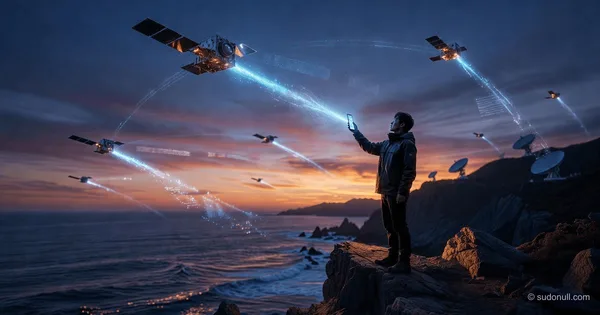
The Sun-Terahertz telescope on the ISS will allow forecasting space weather with an accuracy of 10–15 minutes. Find out how this will affect satellites and defense.
Create an autonomous wireless outdoor temperature sensor: detailed guide on energy saving, component selection (supercapacitors, BME280) and enclosure design.
Russia has installed a unique telescope on the ISS to study solar flares. Why is this a breakthrough in astronomy that the West is silent about? Details and insights.
NASA's TESS finds a rare exoplanet system where orbits shift so fast humans can see it. Three wildly different planets reveal planetary evolution in action.
The new Rubin Observatory just found thousands of asteroids—including near-Earth objects—in early tests. Learn why this matters for science and planetary safety.
Artemis 2 astronauts will see a 53-minute solar eclipse from beyond the Moon—a first in human history. Discover why it matters for science and everyday life.
Solar and wind met all new power demand in 2025, a historic tipping point for the global energy mix. Learn what this shift means for prices and climate.
From the web
3 days ago ·
https://science.nasa.gov/solar-system/
3 days ago · Our solar system includes the Sun, eight planets, five officially named dwarf planets, hundreds of moons, and thousands of asteroids and comets.
2 days ago ·
https://www.britannica.com/science/solar-system
2 days ago · Solar system , assemblage consisting of the Sun and those bodies orbiting it: 8 planets with more than 400 known planetary satellites; many asteroids, some with their own satellites; comets and other icy bodies; and vast reaches of highly tenuous gas and dust known as the interplanetary medium.
Jul 20, 2026 · The solar system is our cosmic neighborhood: the Sun and everything gravitationally bound to it, including eight planets, dozens of known moons, dwarf planets, asteroids, comets, dust, and vast amounts of smaller debris. It stretches far beyond the orbit of Neptune, with the Sun’s gravitational influence extending into an enormous region of space. Although we often picture the solar system ...
May 30, 2022 · Solar System What is a solar system ? A solar system is essentially a star orbited by one or more planets bound to it by its gravitational pull. Our solar system is home to eight planets, several dwarf planets, over 200 moons, countless asteroids, comets, meteors, and other forms of planetary debris.