# Dual-Battery Range Extender Architecture for Cybertruck: Tesla Patent Details
Tesla has patented a system with a main 800 V battery and an additional 400 V battery to extend the Cybertruck's range. The extra pack connects through a pair of parallel DC/DC converters that synchronize voltages. The converters dynamically step up or step down the voltage depending on load and operating mode.
This architecture solves the voltage mismatch issue common in hybrid battery systems. The main battery powers the pickup's high-voltage bus, while the auxiliary battery expands capacity without a complete overhaul of the onboard electrical system.
Options for Integrating the Additional Battery
The patent describes two placement scenarios:
- In the pickup bed: the pack mounts similarly to the canceled Range Extender, occupying part of the cargo bed.
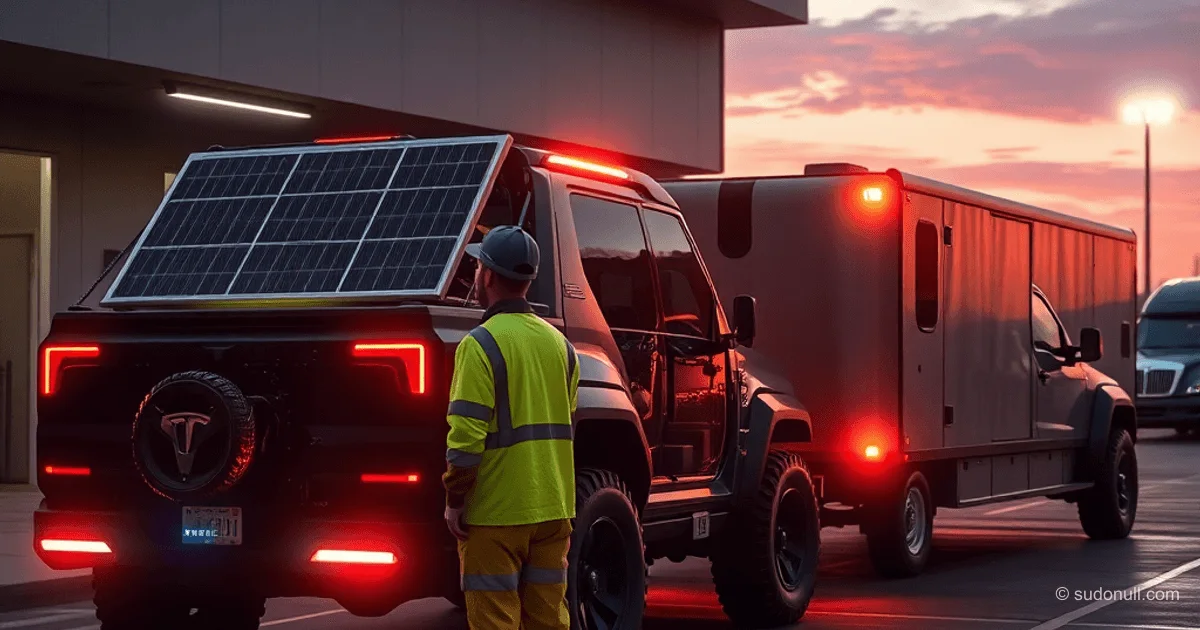
- In a trailer: the battery is housed in a towed module connected via a high-voltage connector at the hitch. This preserves the bed's cargo volume.
The trailer option includes MC4 connectors for integrating solar panels. They charge the auxiliary battery directly, minimizing conversion losses.
The system uses parallel DC/DC connections for current balancing. In discharge mode, both batteries operate in sync; during charging, priority goes to the main battery to optimize efficiency.
History of the Range Extender and Range Issues
At the end of 2023, Tesla announced the Range Extender for $16,000—a module taking up about a third of the bed and promising +715 km of range. Deliveries were planned for early 2025, but the project was canceled.
The Cybertruck disappointed with its real-world range:
| Version | Promised Range | Actual Range |
|-------------|----------------|--------------|
| Tri-motor | 800 km | 510 km |
| Dual-motor | — | 520 km |
The tri-motor version's price climbed above $70,000, fueling more criticism. The new patent addresses these pain points with modular architecture that doesn't sacrifice cargo space.
Technical Advantages of DC/DC Integration
The parallel converters provide:
- Voltage flexibility: 400 V steps up to 800 V for the main bus or steps down for balancing.
- System isolation: the auxiliary battery doesn't impact high-voltage bus safety.
- Scalability: support for multiple packs in series for ultra-long-range missions.
- Charging efficiency: trailer-mounted solar panels directly feed the 400 V pack, cutting thermal losses.
The patent highlights compatibility with the Cybertruck's existing architecture (48 V low-voltage + 800 V HV). This simplifies certification and integration without a platform redesign.
Key Takeaways
- The main 800 V battery pairs with a 400 V pack via two DC/DC converters for synchronization.
- Trailer placement preserves bed space, with MC4 support for solar panels.
- Addresses canceled Range Extender issues: +715 km without losing space.
- Cybertruck's actual range: 510–520 km vs. promised 800 km.
- Scalable architecture for multi-pack setups.
— Editorial Team










No comments yet.