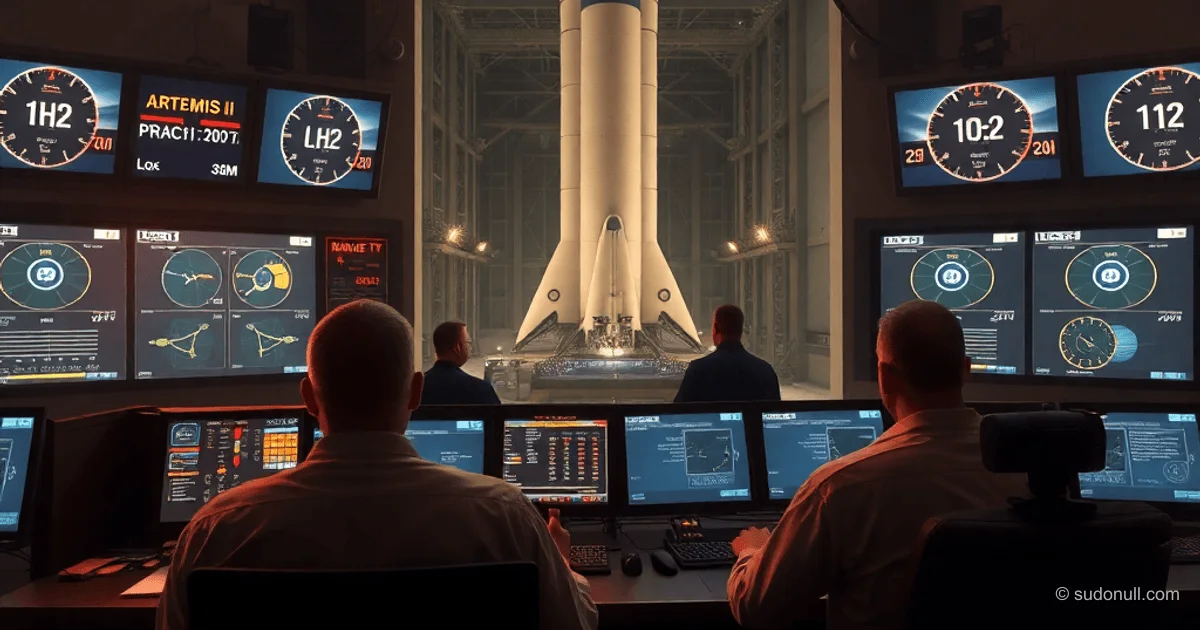
SLS Cryogenic Fueling Timeline for Artemis II: Stages and Procedures
Artemis Launch Director Charlie Blackwell-Thompson gave the go-ahead for fueling the Space Launch System (SLS) rocket at 07:33 EDT. Teams began chilling down the liquid oxygen (LOX) and liquid hydrogen (LH2) feedlines for the core stage. Prior to this, the rocket's cavities were inerted with gaseous nitrogen to reduce the risk of ignition.
The countdown started on March 30 at 16:44 EDT and was in a planned hold for final system checks. Chilling prevents thermal shock by cooling components to cryogenic temperatures before fuel loading.
Core Stage Fueling Stages
Core stage fueling follows a strict sequence:
L-10H40M - L-10H35M: LOX feedline chilldown.L-10H40M - L-9H55M: LH2 feedline chilldown.L-10H25M - L-9H40M: Main LOX system chilldown.L-9H55M - L-9H25M: Slow fill LH2.L-9H40M - L-9H30M: Slow fill LOX.L-9H30M - L-6H40M: Fast fill LOX.L-9H25M - L-8H: Fast fill LH2.L-8H - L-7H55M: Topping LH2.L-7H55M - terminal count: Replenish LH2.L-6H40M - L-6H05M: Topping LOX.L-6H05M - terminal count: Replenish LOX.
At 07:44, feedline chilldown began, followed by slow fill at 08:35 and transition to fast fill LOX at 08:45, LH2 at 09:04. Total volume is about 700,000 gallons of supercooled propellants.
Slow fill ensures gradual cooling, fast fill provides rapid loading. Topping brings levels to full, replenish compensates for boil-off.
ICPS Fueling and Stage Integration
The Interim Cryogenic Propulsion Stage (ICPS) with its RL10 engine is fueled in parallel:
L-9H05M - L-8H30M: LH2 chilldown.L-8H30M - L-7H45M: Fast fill LH2.L-7H20M - L-7H10M: Topping LH2.L-7H05M - terminal count: Replenish LH2.L-6H40M - L-6H30M: LOX chilldown.L-6H30M - L-5H45M: Fast fill LOX.L-5H30M - L-5H10M: Topping LOX.L-5H10M - terminal count: Replenish LOX.
At 09:36, ICPS LH2 chilldown began, fast fill at 09:52. Topping LH2 started at 11:09, replenish at 11:15. Fast fill LOX at 11:42, topping at 12:40. By 12:51, all stages were in replenish.
Final Pre-Launch Procedures
At 10:24, the core stage transitioned to topping LH2, replenish at 10:35. LOX replenish at 12:03. At 12:40, the crew received a weather briefing: 80% chance of favorable conditions, risks include clouds, wind, precipitation.
A planned hold of 1 hour 10 minutes allowed verification of cryogenic fueling, RS-25 engines, and communications. Final sequence:
T-6M: Ready for tank pressurization.T-5M57S: Stop LH2 core replenish.T-4M40S: LH2 purge verification.T-4M: Stop LOX core replenish.T-3M30S: Stop LOX ICPS.T-50S: Stop LH2 ICPS.T-33S: Go for automated launch sequencer.T-30S: Handover to onboard sequencer.T-12S: Hydrogen igniters.T-10S: RS-25 start.T-6.36S: RS-25 ignition.T-0: Booster ignition.
The crew—Reid Wiseman, Victor Glover, Christina Koch, Jeremy Hansen—woke up at 09:25.
Key Takeaways
- Chilldown is critical to prevent thermal shock in cryogenic systems.
- Replenish compensates for LH2/LOX boil-off, ensuring stability until T-0.
- Automated sequencer takes control 33 seconds before launch.
- ICPS boosts Orion to a high orbit for rendezvous and TLI demonstration.
- Weather briefing accounts for risks in a crewed launch.
— Editorial Team










No comments yet.