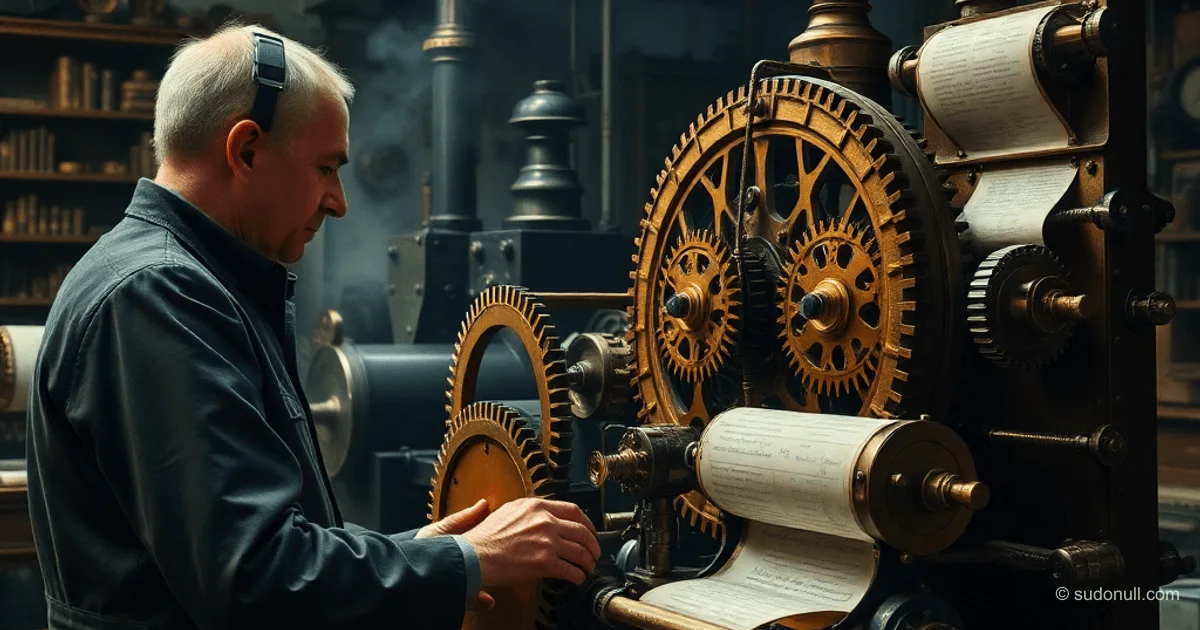
The Dawn of the Digital Revolution: From Mechanical Calculators to the First Computers
The digital revolution has its roots in mechanical devices from the 17th century. Pascal's calculator could only perform addition, while Leibniz's machine already supported all basic operations: addition, subtraction, multiplication, and division. The Antikythera mechanism, possibly created by Archimedes, modeled planetary motion but not arithmetic.
By the 19th century, computing functions became a necessity for engineers. Trigonometric and logarithmic functions were approximated using Taylor series—sums of polynomials with rapid convergence.
Manual calculations led to errors. For example, William Shanks spent 15 years calculating π to 707 digits but made a mistake at the 528th digit, which distorted the next 180 digits.
Babbage's Difference Engine
Charles Babbage proposed a mechanical machine to approximate functions using the first N terms of a Taylor series. The algorithm used differences between successive polynomial values, allowing efficient summation based on previous results.
The machine stored differences in 6 registers of 18 decimal digits each (gear wheels with 10 teeth). A seventh register held the result. Errors accumulated, so the operator manually corrected the last register (e.g., every few degrees for trigonometry). An audible signal reminded them of this.
Additionally: results were printed on copper plates to eliminate transcription errors.
The project was never completed due to lack of funding, but Georg Scheutz built a simplified version for logarithms, sold to the government. In the late 20th century, enthusiasts assembled the original based on Babbage's drawings.
From the Difference Engine to the Analytical Engine
Manual register correction inspired the analytical engine. It was designed to automatically change register values based on logic, freeing the operator.
Key innovations:
- Programming with punch cards (from Jacquard's loom).
- 1,000 memory cells for intermediate results.
- Support for loops: repeating commands until a condition was met.
- Output: stereotype printing or punch cards.
The machine was planned with 50,000 wheels and steam power—too ambitious for the era. Ada Lovelace wrote the first programs, including an algorithm for Bernoulli numbers with recursive loops.
Electromechanical Evolution: From Z1 to Z3
The second industrial revolution added electric drives to calculators. In 1936, Konrad Zuse began the Z1—a mechanical model on rails, using binary floating-point arithmetic (addition, subtraction, multiplication, division). 64 words of 22 bits each, input via keyboard, area 4 m².
Z2 (1939): relays instead of rails in the processor, input on photographic film punch tape.
Z3 (1941): relays in RAM, square root. Practically used for aircraft aerodynamics. Speed: addition 0.8 s, multiplication 3 s. Loops—by splicing punch tape, without conditional jumps.
Comparison with Mark I
| Characteristic | Z3 | Mark I |
|---------------|----|--------|
| Memory (words) | 64 (22 bits) | 72 |
| Addition | 0.8 s | 0.3 s |
| Multiplication | 3 s | 6 s |
| Numeral system | binary | decimal |
| Input | punch tape | punch tape |
| Size | compact | 17×2.5 m |
Mark I (1944, Howard Aiken)—relay-based, loops via punch tape loops.
Key Takeaways
- Mechanical machines solved the problem of errors in manual function calculations using Taylor series.
- Punch cards and loops in the analytical engine laid the foundations of programming.
- Z3—the first functional digital computer (1941), a precursor to Turing-complete machines.
- The transition from mechanics to relays sped up calculations but retained speed and memory limitations.
- Legacy: from gear wheels to modern approximation algorithms.
— Editorial Team










No comments yet.