
 March 6, 2019 at 14:05
Mathematics Reconciling Newton with the Quantum World
- Transfer
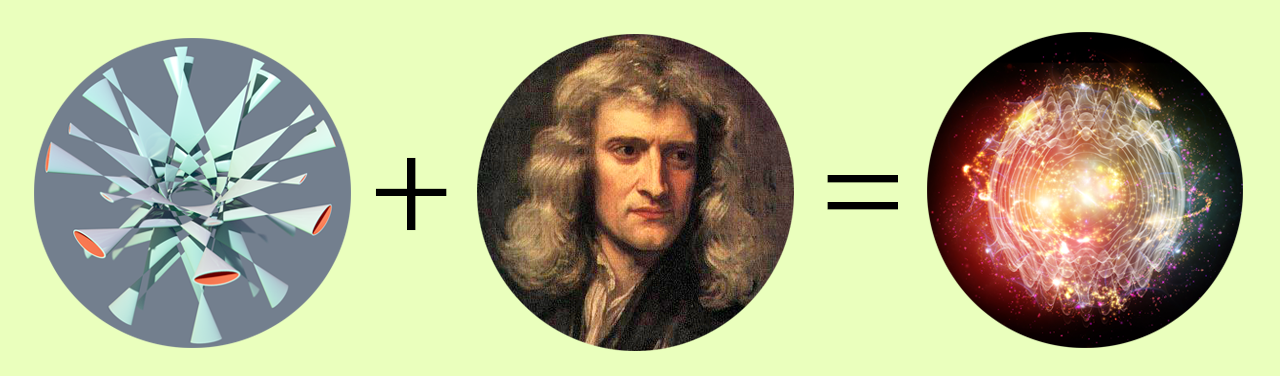
As a professor of mathematics, he ceased to be afraid and fell in love with algebraic geometry.
At the sixth dozen, it’s too late to become a real specialist in algebraic geometry, but I finally managed to fall in love with her. As its name implies, this branch of mathematics uses algebra to study geometry. Around 1637, Rene Descartes laid the foundation of this field of knowledge, taking a plane, mentally drawing a grid on it and designating the coordinates for x and y . You can write an equation of the form x 2 + y 2 = 1, and get a curve consisting of points whose coordinates satisfy this equation. In this example, we get a circle.
For that time, it was a revolutionary idea, because it allows us to systematically convert questions of geometry into questions about equations that can be solved with sufficient knowledge of algebra. Some mathematicians have been involved in this magnificent field all their lives. Until recently, I did not like it, but I was able to connect it with my interest in quantum physics.
In childhood, I liked physics more than mathematics. My uncle Albert Baez, father of the famous folk singer Joan Baez, worked for UNESCO and helped developing countries with physics training. My parents lived in Washington. When my uncle came to the city, he opened his briefcase, pulled out magnets or holograms from there, and with their help he explained physics to me. It was awesome. When I was eight years old, he presented me with a physics textbook he wrote for college. Although I could not understand him, I immediately realized that I wantedof this. I decided to become a physicist, and my parents were worried because I knew that physics needed mathematics, and I was not very strong at it. The division in the column seemed unbearably boring to me, and I refused to do the homework in mathematics with its endlessly repeating routine. But later, when I realized that playing with the equations, I could learn more about the Universe, it fascinated me. Mysterious symbols were like magic spells, and in a way it was. Science is magic that actually works.
In college, I chose mathematics as the main subject, and became interested in the question of theoretical physicist Eugene Wigner about the “inexplicable effectiveness” of mathematics: why is our Universe so readily subject to mathematical laws? He formulated it this way: "The miracle of the adequacy of the language of mathematics for the formulation of the laws of physics is an amazing gift that we do not comprehend and do not deserve." As a young optimist, I felt that these laws would give us hints for solving a deeper puzzle: why the Universe is generally governed by mathematical laws. I already understood that mathematics is too voluminous to study it in its entirety, so in the magistracy decided to focus on what was important to me. And one of those that did not seem important to me was algebraic geometry.
How can a mathematician not fall in love with algebraic geometry? The reason is as follows: in its classical form, this field studies only polynomial equations — equations that describe not just curves, but also figures of a higher dimension, called “manifolds”. That is, x 2 + y 2 = 1 - this is normal, as x 43 - 2 xy 2 = y 7. But an equation with sines, cosines, or other functions is outside this area, unless we find some way to convert it into an equation of polynomials. For a graduate student, this seemed like a terrible limitation. After all, physics uses many functions that are not polynomials.
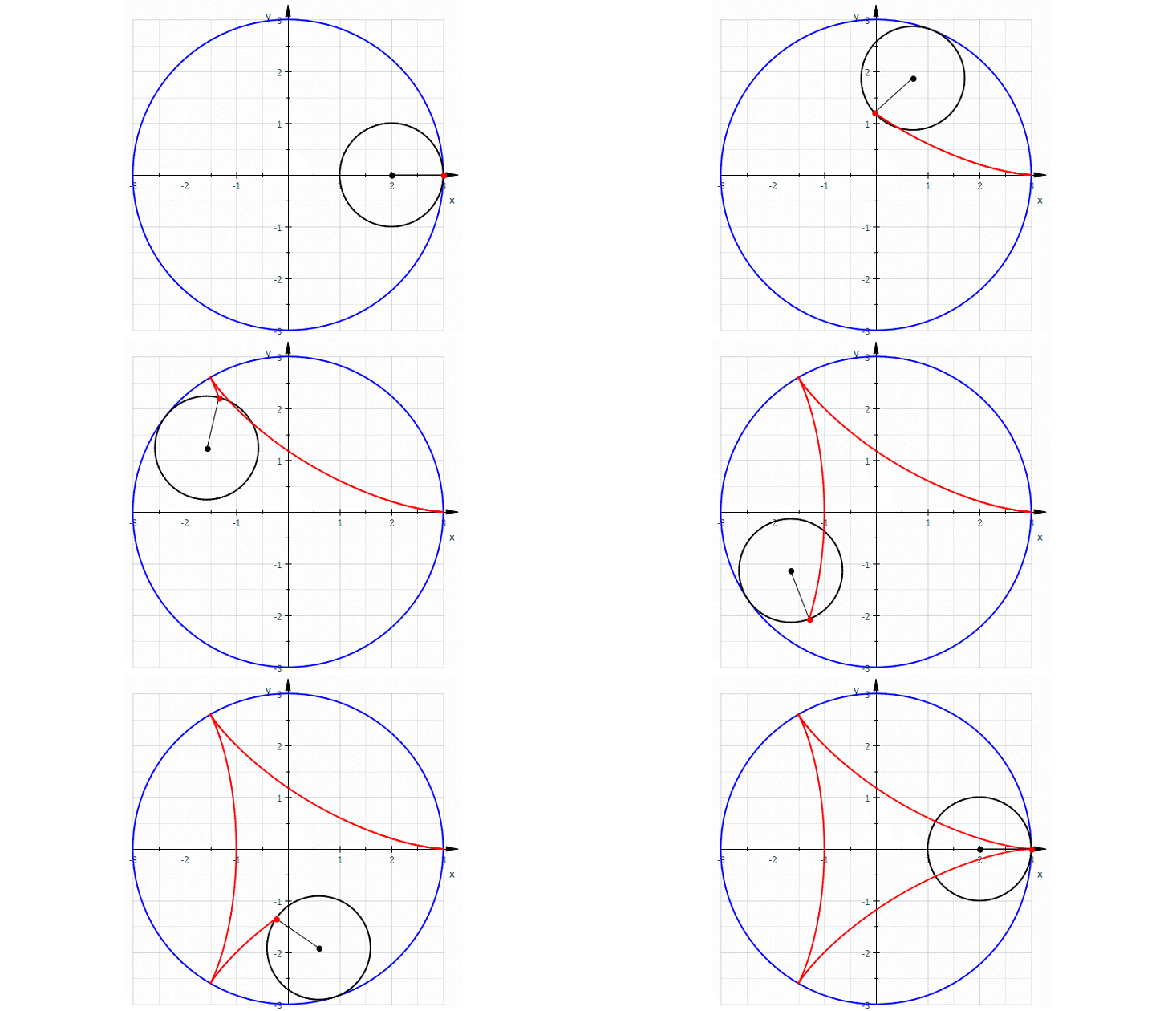
There is a polynomial for this: using polynomials alone, many interesting curves can be described. For example, let's roll a circle inside another circle three times larger. We get a curve with three sharp corners, which is called a "deltoid." It is not obvious what can be described by its polynomial equation, but it is. The great mathematician Leonard Euler invented it in 1745.
Why does algebraic geometry limit itself to polynomials? Mathematicians study all kinds of functions, but although they are very important, at some level their complexity only distracts from the fundamental mysteries of the connection between geometry and algebra. By limiting the breadth of his searches, algebraic geometry can explore these puzzles more deeply. She has been engaged in this for centuries, and now the skill with polynomials is truly amazing: algebraic geometry has become a powerful tool in number theory, cryptography and many other fields. But for her true admirers, the value of this area lies in itself.
Once I met a Harvard graduate student and asked him what he was studying. In a pompous tone, he said one word: "Hartshorn." He meant Robin Hartshorn’s textbookAlgebraic Geometry , published in 1977. It is supposed that it should become an introduction to the subject, but is actually very complex. To quote a description from Wikipedia: “The first chapter, entitled“ Manifolds, ”talks about the classical algebraic geometry of varieties over algebraically closed fields. This chapter uses many classical results from commutative algebra, including the Hilbert zeros theorem, and references to the books of Atiyah-MacDonald, Matsumura and Zarissky-Samuel are often found. ”
If you didn’t understand anything ... then this is what I had in mind. To understand even the first chapter of Hartshorn, you need a fairly large amount of background knowledge. Reading Hartshorn is like trying to catch up with the geniuses of many centuries who have been striving to run as fast as they can.

Famous Cubic: This is Cayley's cubic nodal surface. It is famous for the fact that it is the manifold with the largest number of nodes (such sharp pieces) that can be described by the cubic equation. The equation has the form ( xy + yz + zx ) (1 - x - y - z ) xyz = 0 and is called "cubic" because at the same time we multiply no more than three variables.
One of these geniuses was the scientific director of Hartshorn - Alexander Grotendik. From about 1960 to 1970, Grothendieck made a revolutionary revolution in algebraic geometry, making it part of an epic journey with the aim of proving Weyl's hypotheses connecting varieties with solutions to problems from number theory. Grothendieck suggested that Weil’s hypotheses could be confirmed by strengthening and deepening the connection between geometry and algebra. He had a clear idea of how this should happen. But to ensure the accuracy of this idea, enormous work was required. To fulfill it, he organized a seminar. Grothendieck made presentations almost every day and took advantage of the help of the best mathematicians in Paris.

Let's run a math-background: Alexander Grotendik at his seminar.
Working non-stop for a decade, they wrote thousands of pages of new math filled with stunning concepts. In the end, using these ideas, Grothendieck successfully proved all Weyl's hypotheses, except the last, the most complex. To Grothendieck's surprise, it was decided by his student.
During his most productive years, even though he dominated the French school of algebraic geometry, many mathematicians considered Grothendieck's ideas "too abstract." That sounds a little strange considering how abstract the wholemaths. But it is undoubted that time and effort are required to perceive his ideas. As a graduate student, I tried to distance myself from them, because I was actively struggling with the study of physics: geniuses also worked for centuries at full speed in it, and to get to the frontier, it takes a long time to catch up. But later, when I started my career, my studies led me to the work of Grothendieck.
If I chose a different path, I could approach his work through the study of string theory. Physicists studying string theory postulate that in addition to the visible dimensions of space and time (three dimensions for space and one for time) there are additional dimensions of space, so twisted that they cannot be seen. In some of their theories, these additional dimensions form diversity. Therefore, string theory researchers can easily come across complex questions from algebraic geometry. And this, in turn, makes them face the Grothendieck.

I’m completely confused: a slice of one variety called the “quintic threefold”, which can be used to describe additional convoluted dimensions of space in string theory.
And indeed. best of all, string theory is advertised not by a successful prediction of experimental results - it absolutely cannot boast of this - but by the ability to solve problems within the framework of pure mathematics, including algebraic geometry. For example, string theory can amazingly well calculate the number of curves of different types that can be drawn in certain varieties. Therefore, today one can see string theorists communicating with algebraic geometers, and each side can surprise the other with its discoveries.
But the source of my personal interest in the work of Grothendieck was different. I've always had serious doubts about string theory, and counting curves in varieties is the last thing I would like to do: it's like climbing - it's very exciting to watch, but too scary to do it yourself. It turned out that the ideas of Grothendieck are so generalized and strong that they extend beyond the boundaries of algebraic geometry to many other areas. In particular, I was impressed with his 600-page unpublished manuscript Pursuing Stacks , written in 1983. In it, he states that topology(if to explain in a broad sense, this is the theory of what forms a space can take if we are not worried about its bending or stretching, but only the types of holes are of interest) can be completely reduced to algebra!
At first, this idea may seem similar to algebraic geometry, in which we use algebra to describe geometric figures (for example, curves or manifolds of higher dimension). But it turns out that “algebraic topology” has a completely different flavor, because in topology we are not obliged to limit ourselves to figures described by polynomial equations. Instead of working with beautiful jewelry, we are dealing with flexible, soft clots; therefore we need a different algebra.

If you need an explanation: mathematicians sometimes joke that topologists don’t see the difference between a donut and a cup of coffee.
Algebraic topology is a beautiful area that existed long before Grothendieck, but he was one of the first who seriously proposed a method of reducing the wholetopology to algebra. Thanks to my work in physics, his proposal seemed extremely delightful to me. And here's why: at that moment I took on the difficult task of combining the two best theories of physics: quantum physics, which describes all the forces except gravity, and the general theory of relativity, which describes gravity. It seems that until we do this, our understanding of the fundamental laws of physics is doomed to be incomplete. But to realize this is damn difficult. The reason is that quantum physics is based on algebra, and topology is actively used in the general theory of relativity. But this tells us the direction of the attack: if we can figure out how to reduce topology to algebra, then this may help us formulate the theory of quantum gravity.
My physics colleagues at this moment would howl and start complaining that I’m simplifying everything too much: in quantum physics not just algebra is used, but the general theory of relativity is not only topology. Nevertheless, it was precisely the possible physical advantages of reducing topology to algebra that delighted me in Grothendieck's work.
Therefore, since the 1990s, I have been trying to figure out the powerful abstract concepts invented by Grothendieck, and to date have achieved partial success. Some mathematicians consider these concepts a complex part of algebraic geometry. But now they seem to me a simple part. For me, not all these abstract concepts, but their boring details, became a difficult part. Firstly, this is all the material in the texts that Hartshorn considers mandatory prerequisites: "the books of Atiyah-MacDonald, Matsumura and Zarissky-Samuel", and these are huge volumes of algebra. But there is much more.
Therefore, although I now have a partof what is necessary for reading Hartshorn, until recently, the study of these materials was too scary for me. A physics student once asked a famous specialist how much mathematics a physicist should know. The specialist replied: "More than he knows." Indeed, the study of mathematics can never be considered complete, so I focused on aspects that seemed most important and / or interesting. Until last year, algebraic geometry was never at the top of this list.
What has changed? I realized that algebraic geometry is related to the relationship between classical and quantum physics. Classical physics is Newtonian physics, in which we assume that we can measure everything with complete accuracy, even in theory. Quantum physics is the physics of Schrödinger and Heisenberg, it is governed by the principle of uncertainty: if we measure some aspects of a physical system with complete accuracy, others must remain uncertain.
For example, any rotating object has an "angular momentum." In classical mechanics, we visualize it with an arrow directed along the axis of rotation, and the length of this arrow is proportional to the speed of rotation of the object. And in classical mechanics, we assume that we can accurately measure this arrow. In quantum mechanics - a more accurate description of reality - this turns out to be wrong. For example, if we know how far the arrow points in the x directionthen we can’t find out. how far she points in the y direction . This uncertainty is too small to be noticed for a basketball, but for an electron it is very significant: until physicists began to take this into account, they only had a rough understanding of electrons.
Physicists often seek to “quantify” the problems of classical physics. That is, they start with the classical description of some physical system and try to derive a quantum description. To carry out this work, there is no general and completely systematic procedure. And this should not surprise you: these two views on the world are very different. However existuseful recipes for performing quantization. The most systematic of them are applicable to a very limited set of physical problems.
For example, in classical physics, we can sometimes describe a system as a point in manifold . You should not expect that this is possible in the general case, but in many important cases this happens. For example, consider a rotating object: if we fix the length of the arrow of its angular momentum, then the arrow can still point in any direction, that is, its end should lie on a sphere. Thus, we can describe a rotating object with a point on a sphere. And this sphere is actually a variety, the “ Riemann sphere ”, named after one of the greatest algebraic geometers of the 19th century Bernhard Riemann.

Diversity: the eighth-order Endrass surface is a beautiful, highly symmetric example of “manifold”: a figure described by polynomial equations. Algebraic geometry began as a study of such figures.
When the task of classical physics is described by diversity, magic happens. The quantization process is becoming completely systematic and surprisingly simple. There is even a kind of reverse process, which can be called "classification" - it allows you to convert a quantum description back into a classical description. The classical and quantum approaches to physics are becoming closely related, we can take ideas from any approach and observe what they can tell us about other things. For example, each point in the manifold describes not only the state of the classical system - in our example, this is the specific direction of the angular momentum - but also the state of the corresponding quantum system, even though the latter is controlled by the uncertainty principleHeisenberg. A quantum state is the "best quantum approximation" to the classical state. Moreover, in this situation, many basic theorems from algebraic geometry can be considered as facts about quantization. Since I have been engaged in quantization for a long time, it makes me extremely happy.
Richard Feynman once said that in order to advance in solving a complex physical problem he needs to look at it from a special angle:
"[...] I need to think that I have some shortest way to solve the current problem. That is, it’s as if I have a talent that others don’t use, or a special look that they foolishly did not consider to be an excellent view of things. I need to think that for some reason my chances are higher than those of others, I know deep down that this reason is most likely false, and most likely the view I have chosen has already been used by others, but it doesn’t bother me: I’m deceiving convincing myself that I have an extra chance. "
Perhaps this is exactly what I until recently lacked in algebraic geometry. Of course, algebraic geometry is not just a problem to be solved, but a complex of knowledge - but it is such a huge, frightening set that I did not dare to touch it until I found this shortest path. Now I can read Hartshorn, translate some of the results into facts about physics, and I have a chance to understand all this. This is an excellent feeling.
About the Author : John Baez is a professor of mathematics at the University of California at Riverside and a visiting researcher at the Singapore Center for Quantum Technologies. He runs an Azimuth blog about math, science, and environmental issues. Follow him on Twitter: @johncarlosbaez .