
 April 13, 2017 at 15:11
VR development methodology
- Transfer
This article is the last in a series about the quality development of VR projects. Earlier, we already studied the principles of selecting content for our projects in the article “VR Design: Scene Content” . Links to other materials can be found in the review article .
Developing projects with virtual reality is not an easy task, not only because VR is a very young means of communication. The capabilities and limitations of the technology make development quite complex.
How to meet such requirements in order to develop good VR projects, we will learn in this article.
After we went over the main features of VR development in this series of articles, we will consider the last, most important for you, as a developer, tool: iterative development process.
We will also analyze why you cannot always trust yourself and what the concept of “VR legs” means.
In fact, when developing this kind of project, it’s not worthwhile to plan a lot and a lot, it’s better to constantly test changes and ideas.
During short development cycles, you will find out how fast everything works and what aspects of the VR project still need to be improved. So you will quickly reach the goal and, in most cases, you will get the best result.
It is for the development of virtual reality that constant feedbacks are very important.
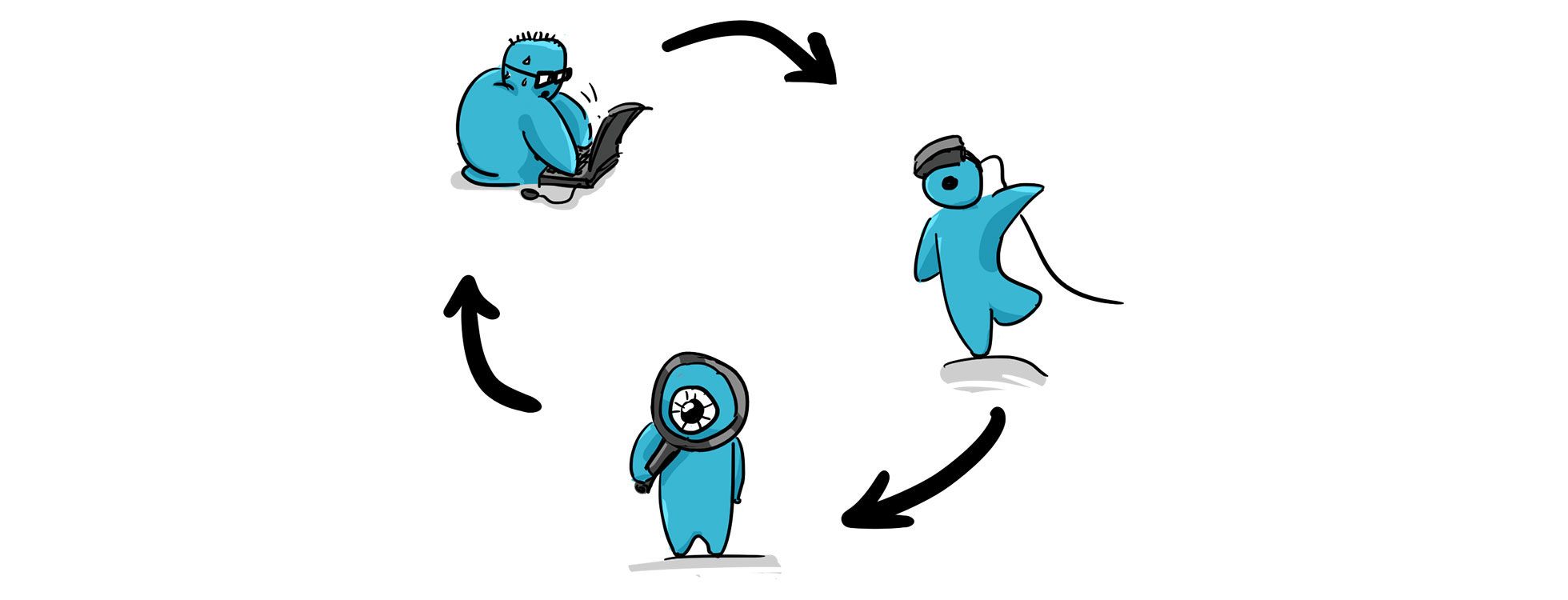
The process that I will show you consists of three steps: planning, implementation and analysis. And he repeats all the time.
At the same time, you develop prototypes, learn with the help of user experience and constantly improve projects thanks to new knowledge.
In fact, cool ideas often come up randomly or, as Bob Ross said, thanks to “happy accidents”. There are a huge number of VR projects that have been partially or completely redesigned due to the excellent opening during development.
VR projects cannot be calculated or perfectly planned. Compared to other areas of development, there are few examples and standards for VR that you can cling to.
With at least a little programming experience, everyone can quickly develop simple prototypes to debug or refine an idea.
But when it comes to the basics, of course, you will need extensive programming knowledge. I advise anyone who wants to work in the field of VR to acquire basic programming knowledge.
The very opportunity to try ideas right in VR and play with them is already sufficient and can lead to better and more creative solutions.
You start with an idea or TK and plan the first iteration of the project. However, already at this point it is worth considering that you will have to plan for subsequent iterations. What could be the first step you can build?
Rid yourself of long and extensive plans. It will take you too much time and, more often than not, you will have to plan what you do not know yet.
Already during development, you will receive answers to questions. But, most often, at first you still don’t know what you will meet. So, do not stay long in the planning phase and do not try to formulate everything in the smallest detail.
Focus on the central idea first, the simplest components of a project. Should it be a virtual archery simulation? Then first concentrate on the interaction of the bow and arrows, even before you make the landscape, menu and physical calculations.
The overall goal is undoubtedly important, and you should not lose sight of it. This coarse separation is enough to guide decisions during development.
After you have thought over and prepared the next significant step, for example, a new improvement, it is worth starting implementation immediately.
You will either develop prototypes - for example, for interaction, which will then be important in the analysis - or optimize the existing aspect of the project based on the experience you gained during the analysis and planning.
Prototypes are very useful, as you can test and improve ideas or functionality separately from the rest of the project. This greatly reduces the number of dependencies and the complexity of the project.
During the development phase, you should always keep in focus the currently necessary part of the project. If, for example, you create a prototype of the interaction of a bow and arrows, it is very important that you concentrate on programming the interaction and so far exclude everything else from view.
In this situation, you can find the missing component in the Asset Store. As part of the described example, you could simply find 3D models for the surroundings, bow and arrows in this store and embed it in your prototype.
Later, when you are satisfied with the mechanics, you will be able, if necessary, to do better graphics.
In fact, you should always focus on what you already know and what you like. If possible, you will transfer the remaining tasks to others or the Asset Store will help you.
If you are still not so good at programming, but still would like to debug your first ideas in the virtual world, I will advise you Unity Play Maker , a simple tool for visual programming.
After you have developed a prototype or improved a part of your project, the next step comes - tests and analysis.
This third part of the process is very important and is central to the development of high-quality projects. Since only during the tests you will find out what ideas from the planning phase really work in the virtual world.
During this phase, you should always put on VR glasses on yourself and your team and feel the innovations in the project.
But it is also necessary that you, when developing important aspects - for example, the main ways of interaction - attract other people to test VR-sensations and get feedback.
Think about how people react to the virtual world in very different ways, and get information about whether they are already immersed in VR.
Since one who often plunges into virtual worlds develops immunity to motion sickness over time. This is often referred to as “VR legs”.
On the contrary, people who have never used VR glasses for the first time may be so overwhelmed by new experiences that their reaction to VR disappears.
Often you get ideas of what, from the point of view of testers, would be the best solution. Here you need to be careful and not implement these proposals immediately, but perceive them as inspiration.
Since testers, unlike you, do not know all the ideas of the project. Here you better understand what is suitable for the general concept and what is not.
But you must listen to everything in detail, if necessary, ask further questions in order to understand the real problem that lies behind the proposal. Since it is precisely these comments that are valuable.
Take them with you to the next phase of planning, and you will be inspired by what new ideas and improvements come from this!
At the center of the VR project is the user experience (UX). If during the development of the project UX is constantly improving, then you are on the right track.
After these three phases, you gained a lot of experience. Here the process begins again, the planning phase. Now you can transfer your new knowledge to practice in a new iteration.
The duration of the iteration of these three phases is completely different. From a few minutes - changed the variables and tested the effect - up to a couple of days or even weeks, everything is possible.
In addition, there is no need to strictly limit yourself to the scope of the process and, if this is required by the way of work or the project itself, change the process or develop a new one. It is important that you consciously adhere to the process, but not too strictly.
If you are starting your VR project and looking for advice, or you already need a feedback for your development, contact me !
Developing projects with virtual reality is not an easy task, not only because VR is a very young means of communication. The capabilities and limitations of the technology make development quite complex.
How to meet such requirements in order to develop good VR projects, we will learn in this article.
After we went over the main features of VR development in this series of articles, we will consider the last, most important for you, as a developer, tool: iterative development process.
We will also analyze why you cannot always trust yourself and what the concept of “VR legs” means.
You have to be super experimental and be willing to accept that a lot of the old ways of doing things just do not work at all anymore.
Joel Green from Cloudhead Games, The Gallery Development Team
Iterative development process
In fact, when developing this kind of project, it’s not worthwhile to plan a lot and a lot, it’s better to constantly test changes and ideas.
During short development cycles, you will find out how fast everything works and what aspects of the VR project still need to be improved. So you will quickly reach the goal and, in most cases, you will get the best result.
It is for the development of virtual reality that constant feedbacks are very important.
The process that I will show you consists of three steps: planning, implementation and analysis. And he repeats all the time.
At the same time, you develop prototypes, learn with the help of user experience and constantly improve projects thanks to new knowledge.
In fact, cool ideas often come up randomly or, as Bob Ross said, thanks to “happy accidents”. There are a huge number of VR projects that have been partially or completely redesigned due to the excellent opening during development.
VR projects cannot be calculated or perfectly planned. Compared to other areas of development, there are few examples and standards for VR that you can cling to.
With at least a little programming experience, everyone can quickly develop simple prototypes to debug or refine an idea.
But when it comes to the basics, of course, you will need extensive programming knowledge. I advise anyone who wants to work in the field of VR to acquire basic programming knowledge.
The very opportunity to try ideas right in VR and play with them is already sufficient and can lead to better and more creative solutions.
1: Planning
You start with an idea or TK and plan the first iteration of the project. However, already at this point it is worth considering that you will have to plan for subsequent iterations. What could be the first step you can build?
Rid yourself of long and extensive plans. It will take you too much time and, more often than not, you will have to plan what you do not know yet.
Already during development, you will receive answers to questions. But, most often, at first you still don’t know what you will meet. So, do not stay long in the planning phase and do not try to formulate everything in the smallest detail.
Focus on the central idea first, the simplest components of a project. Should it be a virtual archery simulation? Then first concentrate on the interaction of the bow and arrows, even before you make the landscape, menu and physical calculations.
The overall goal is undoubtedly important, and you should not lose sight of it. This coarse separation is enough to guide decisions during development.
... spend time in it, and listen to what it does good.
Then develop an experience around that.
Patrick Hackett of Skillman & Hackett (Tilt Brush)
2: Implementation
After you have thought over and prepared the next significant step, for example, a new improvement, it is worth starting implementation immediately.
You will either develop prototypes - for example, for interaction, which will then be important in the analysis - or optimize the existing aspect of the project based on the experience you gained during the analysis and planning.
Prototypes are very useful, as you can test and improve ideas or functionality separately from the rest of the project. This greatly reduces the number of dependencies and the complexity of the project.
During the development phase, you should always keep in focus the currently necessary part of the project. If, for example, you create a prototype of the interaction of a bow and arrows, it is very important that you concentrate on programming the interaction and so far exclude everything else from view.
In this situation, you can find the missing component in the Asset Store. As part of the described example, you could simply find 3D models for the surroundings, bow and arrows in this store and embed it in your prototype.
Later, when you are satisfied with the mechanics, you will be able, if necessary, to do better graphics.
In fact, you should always focus on what you already know and what you like. If possible, you will transfer the remaining tasks to others or the Asset Store will help you.
If you are still not so good at programming, but still would like to debug your first ideas in the virtual world, I will advise you Unity Play Maker , a simple tool for visual programming.
Try to make as many different prototypes as you can. There's a lot of discovery.
Justin Liebregts of Futuretown (Cloudlands: VR Minigolf)
3: Analysis
After you have developed a prototype or improved a part of your project, the next step comes - tests and analysis.
This third part of the process is very important and is central to the development of high-quality projects. Since only during the tests you will find out what ideas from the planning phase really work in the virtual world.
During this phase, you should always put on VR glasses on yourself and your team and feel the innovations in the project.
But it is also necessary that you, when developing important aspects - for example, the main ways of interaction - attract other people to test VR-sensations and get feedback.
Think about how people react to the virtual world in very different ways, and get information about whether they are already immersed in VR.
Since one who often plunges into virtual worlds develops immunity to motion sickness over time. This is often referred to as “VR legs”.
You can never know how good something’s
going to be in VR until you try it out ...
Alex Schwartz of Owlchemy Labs (Job Simulator 2050)
On the contrary, people who have never used VR glasses for the first time may be so overwhelmed by new experiences that their reaction to VR disappears.
Often you get ideas of what, from the point of view of testers, would be the best solution. Here you need to be careful and not implement these proposals immediately, but perceive them as inspiration.
Since testers, unlike you, do not know all the ideas of the project. Here you better understand what is suitable for the general concept and what is not.
But you must listen to everything in detail, if necessary, ask further questions in order to understand the real problem that lies behind the proposal. Since it is precisely these comments that are valuable.
Take them with you to the next phase of planning, and you will be inspired by what new ideas and improvements come from this!
At the center of the VR project is the user experience (UX). If during the development of the project UX is constantly improving, then you are on the right track.
... and again and again!
After these three phases, you gained a lot of experience. Here the process begins again, the planning phase. Now you can transfer your new knowledge to practice in a new iteration.
The duration of the iteration of these three phases is completely different. From a few minutes - changed the variables and tested the effect - up to a couple of days or even weeks, everything is possible.
In addition, there is no need to strictly limit yourself to the scope of the process and, if this is required by the way of work or the project itself, change the process or develop a new one. It is important that you consciously adhere to the process, but not too strictly.
Ditch everything you know about game design, and just try to think of everything as new.
Joachim Holmér of Neat Corp (Budget Cuts)
If you are starting your VR project and looking for advice, or you already need a feedback for your development, contact me !