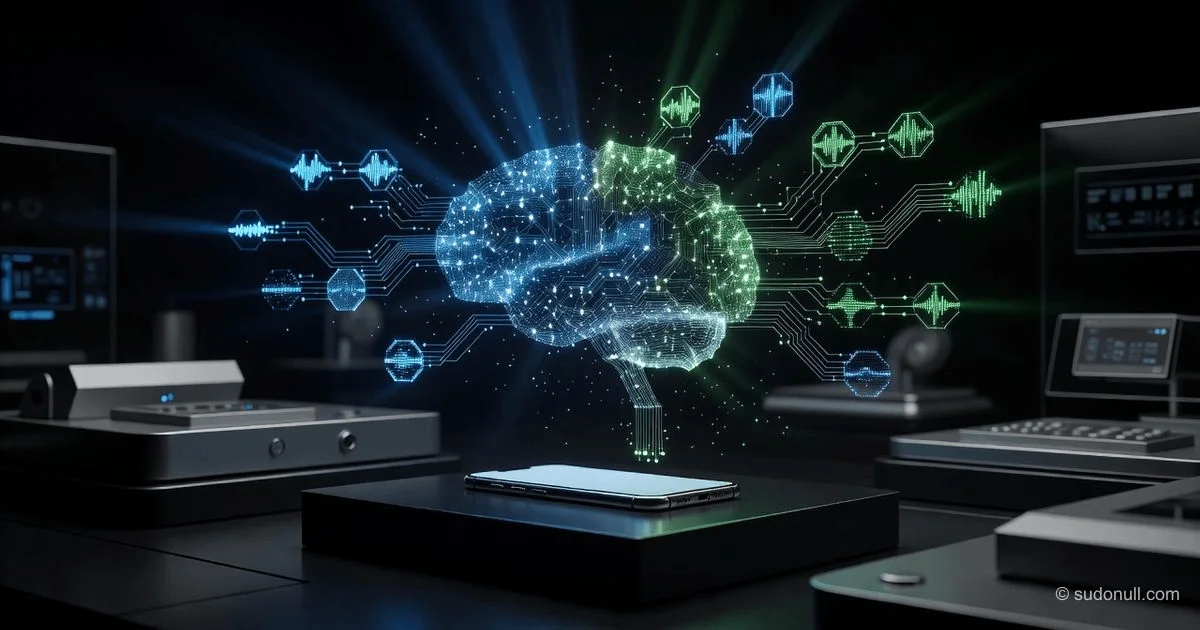
Siri Powered by Google Gemini Debuts at WWDC 2026
At WWDC, starting June 8, Apple will unveil a completely revamped Siri voice assistant running on a custom Google Gemini model. This marks the end of OpenAI's exclusivity on the iPhone.
The Deal of the Century or Cupertino's Kitchen Nightmare: Why Siri on Gemini Is More Than Just a Supplier Switch
This smells not just like a presentation—it smells like panic. Regular users will see a pretty picture on June 8: Tim Cook (possibly for the last time on that stage) smilingly announcing a "new era for Siri." But those who have been sitting in Cupertino and Mountain View boardrooms for the past six months know the truth: a magnitude 9.0 earthquake has hit California. WWDC 2026, starting June 8, will go down in history not as "yet another iOS 27 update" but as the moment Apple officially admitted: they couldn't build their own god-level neural network. And they had to buy brains from their main competitor.
We are witnessing not just a technical integration. It's a shift in philosophy. For decades, Apple sold "Privacy. It just works." The deal with Google was always the dirty secret of search ($20 billion a year for a spot in Safari). But that was just search—links. Now Google becomes the brain of the iPhone. This changes economics and power. Let's break down what's really hidden behind the headline "Siri on Google Gemini."
[The Core]: 1.2 Trillion Parameters and the Illusion of Choice
Media write: "Apple takes Gemini." That's too simplistic. In reality, the deal—quietly announced back in January 2026 and now being unveiled on stage—is much trickier.
Apple pays Google about $1 billion per year (plus options) for access to a custom Gemini model. The key word is "custom." It's not that you say "Hey Siri" and your request flies off to Google's servers. Technically, it's not even roaming.
What's actually happening:
Apple has obtained the right to "distillation." This is a complex term meaning Apple engineers take Google's huge "teacher" model (1.2 trillion parameters, 8 times larger than Apple's current cloud model) and use it to train their own compact Apple Foundation Models. Imagine Google wrote a giant encyclopedia, and Apple extracted the essence of knowledge and rewrote it in their own words, stuffing it into the iPhone. User data when interacting with Siri does not go to Google. But all the intelligence that Siri outputs is generated based on the "knowledge" of Google's giant.
This is a payment for time. Apple Intelligence, shown in 2024 and which never really took off, simply didn't match the level of GPT-4 or Gemini 2.0. An insider tidbit that's being hushed up: internal testing showed that old Siri made context errors in conversations 3 times more often than Gemini. The layoffs in the Siri team at the end of 2025 were not a "rotation" but a purge after failed attempts to build their own large language model over two years.
But there's a catch: Apple built in a "kill switch." Gemini will live in Apple's Private Cloud Compute—servers on Apple Silicon chips (Project "Baltra"), to which Google has no access. This is a marriage of convenience: we give you money ($1 billion) and our ecosystem for your code, but you don't even get a whiff of our users.
[Timeline and Context]: Betrayal of OpenAI and Cold Calculation
To understand the cynicism of what's happening, we need to go back to 2024. At WWDC that year, Apple trotted out Sam Altman (loudly, with fanfare) and announced ChatGPT integration. It was a marriage of necessity: OpenAI provided the brains, Apple provided distribution. The deal was cashless—just barter.
But by 2026, relations had soured. First, OpenAI started demanding more—either money or exclusivity. Second, Elon Musk, who was furious about the OpenAI integration (threatening to ban iPhones at Tesla factories), created a ruckus that forced Apple to keep an eye on its legal department.
The decisive moment came in May 2026, just a few weeks before WWDC. Revelations from courtrooms and analyst reports: OpenAI is considering a lawsuit against Apple. The reason? Violation of the partnership spirit. OpenAI spent resources hoping to become the primary AI for iPhone. But Apple quietly struck a $1 billion deal with Google in January, making ChatGPT just one optional "plugin" in the new Siri interface, alongside Anthropic's Claude.
Apple acted like a classic dictator. They created an AI Marketplace. In iOS 27, Siri gets Extensions—you can choose which "engine" answers your request: Google Gemini (default and primary for the system), ChatGPT (as an option), or Claude. But even if you choose ChatGPT, system functions, calendar, mail, and complex "agent" logic will still be handled by Gemini in the background. This is the death knell for OpenAI's exclusivity.
[Who Wins and Who Loses]
Google (Win: colossal, but with risk).
Google gets $1 billion annually—a drop in the ocean of their ad budget. But the main thing is legitimization. The whole world sees: even Apple considers Gemini the most advanced AI on the planet. This is a blow to the reputations of Microsoft (Copilot) and OpenAI. It allows Google to re-enter the room they were being kicked out of. However, there is also a loss. If Siri on Gemini lags or hallucinates (spouts nonsense), Apple will be blamed, but subconsciously users will decide that "Google is junk." Apple has shifted reputational risk to Google.
Apple (Win: tactical; strategically—humiliation).
Apple saves features. They will finally show Siri that understands context: "Remind me to buy that sweater I sent to Masha in iMessage yesterday at 6 PM." It works. But the price is the soul. Apple has ceased to be a hardware+software company that creates everything itself. It has become an integrator. This boosts their stock price in the moment (PE ratio 37 is very expensive, and they must justify it with AI), but creates dependency on Google. As soon as Google raises the price to $2 billion or $3 billion in two years, Apple will have nowhere to go—their own models haven't caught up.
OpenAI (Loser number one).
This is a catastrophe for Sam Altman. They were used as a springboard. In 2024 they were featured on the world's main stage, and in 2026 they've been pushed to the "other apps" section. Given that the company is burning cash on model training, losing such a distribution channel and facing the threat of lawsuits (which they will likely lose, as the 2024 contract was clearly drafted by Apple's lawyers with a "backup plan" for partner replacement) is a blow to the company's valuation in the next funding round.
NVIDIA (Silent winner).
No one talks about this. "Baltra" is Apple chips, yes. But the giant 1.2 trillion parameter Gemini was trained on NVIDIA clusters. The more such deals, the more hardware Google and Apple need.
[What the Media Aren't Saying]
Ordinary analysts drone on about "user choice." Nonsense. Here's your non-obvious insight: Apple is building a "Digital Brain" to collect behavioral data.
Let's turn on the paranoia. Google does not directly receive your voice commands—that's stipulated. But Apple allows Gemini (its copy) to work with context: emails, photos, geolocation, calendar. This is the most valuable behavioral database in the world. Apple always said it knows nothing about you—everything is on-device. Now, for AI to work, they need to process your data in Apple's cloud. Yes, encrypted. But the algorithms... these algorithms are written based on Google. Who guarantees that data processing patterns aren't tuned so that later, when the contract expires, it hurts Apple to leave? This is a "backdoor" for dependency.
Second, what's being hushed up: Power consumption. Siri 2.0 will drain the battery like no feature before. A 1.2T neural network in the cloud plus local models for simple commands. The presentation will show a beautiful Dynamic Island with animation, but the reality is: iPhone 15 and older users will see their battery melt before their eyes. This is designed to sell iPhone 17 with new neural chips and larger batteries. The Google deal is fuel for hardware sales.
[Forecast: Next 30 Days and 90 Days]
Next 30 days (June–July 2026):
Right after WWDC, a "witch hunt" will begin. Federal regulators (US DOJ) will remember the 2024 Google Search antitrust case and try to veto or demand changes to the deal. Argument: Google uses Apple smartphones to crush competitors (Perplexity, Claude) at the start. Apple will have to publicly humiliate Mark Gurman (Bloomberg) by denying details, but the essence will remain. AAPL shares will get a short-term boost (+5-7%) on hype, but then the market will realize that Services margins are at risk if Google pulls the blanket over itself.
90 days (September–October 2026 – iPhone 17 launch):
Here's where the fun begins—monetization. The media miss that Apple takes up to a 30% commission on subscriptions to premium ChatGPT or Claude features through the App Store within Siri. If a user wants advanced image generation via Gemini, they pay Google, Apple takes its cut (AI tax). This is a new goldmine.
However, after 90 days, the first beta of iOS 27 will be released. We'll see real performance. My forecast: there will be a "response delay" of 0.5-1 second longer than the regular Google Assistant on Pixel, because data is looped: iPhone -> Apple Cloud (Gemini emulation) -> ... Although Google placed servers directly in Apple's data centers, latency will remain. Users will start complaining that Siri has become smarter but slower. And then we'll understand if it was worth it. Apple bought intelligence, selling speed and, perhaps, part of its soul to the eternal rival from Mountain View.
— Editorial Team









No comments yet.