xAI Signs Federal Contract with the U.S. Government
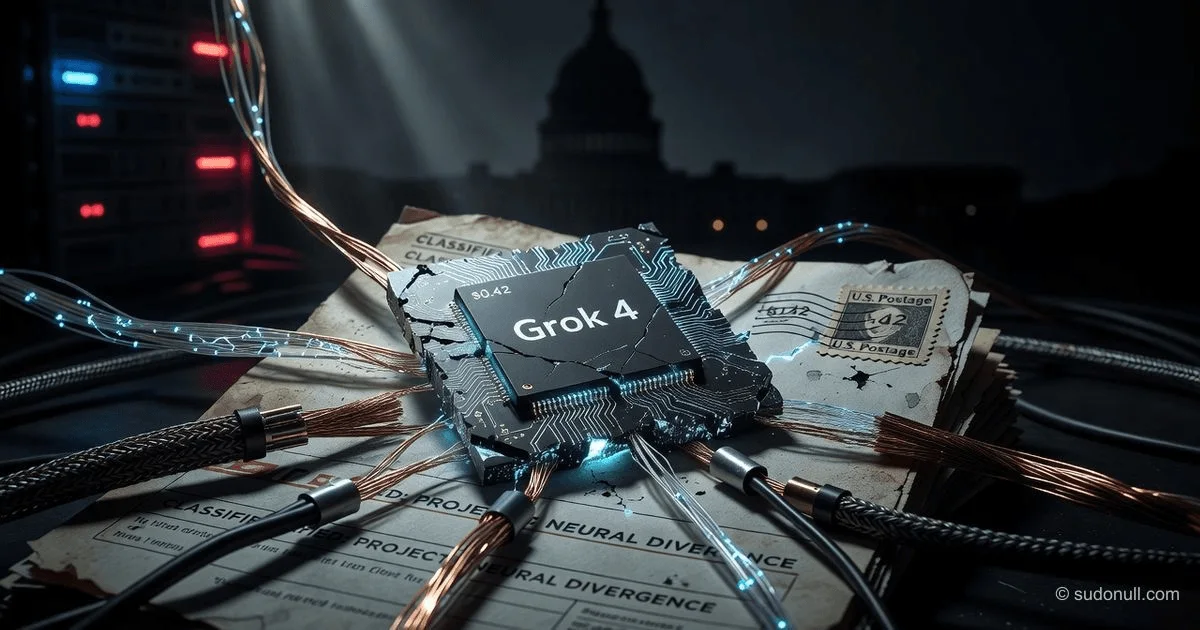
Elon Musk's company xAI has signed an 18-month OneGov agreement with the GSA, granting all federal agencies access to the Grok 4 model at a price of $0.42. This is the longest government AI license to date.
42 Cents per Government Soul: Why the xAI Contract with the U.S. Government Is Not About AI, but About the Last Fight Before Collapse
The official narrative sounds like a triumph: "Elon Musk conquers Washington. xAI signs an 18-month OneGov agreement, giving all federal agencies access to Grok 4 for a measly $0.42." Media outlets trumpet the longest government AI license in history. Investors clap their hands, watching SpaceX's growing market cap, into which xAI has been incorporated.
But I look at the numbers on the table and see not a victory, but sheer panic.
$0.42 per organization is not a price. It's an admission that nobody wants to buy your product for real money. When OpenAI charges $1 for a ChatGPT Enterprise government license, it's a symbolic fee for "good neighborliness." When Google and Anthropic sign full-fledged custom contracts worth millions, that's business. When Musk asks for 42 cents (cheaper than a bottle of water from a military-industrial complex vending machine), it's an attempt to capture market share at any cost, because otherwise he'll be left with nothing.
We're used to seeing Elon Musk as a genius who's always one step ahead. But here, he's catching up. And he needs this contract not to beat competitors, but to somehow justify the financial hole that opened up in xAI after Grok's crushing market failure, and to "lock in" some validation before SpaceX's inevitable IPO. Let's break down why the "deal of the century" turned out to be a "drowning man's deal."
[The Gist]: Selling Hot Air for 42 Cents
The average person thinks: "Wow, the U.S. government chose Grok." No. The U.S. government chose a policy of supplier diversity under the OneGov initiative. This is a program launched by the Trump administration to avoid putting all eggs in the OpenAI and Google basket, and to create artificial competition. Under this program, OpenAI (ChatGPT for $1), Meta (Llama), and Google (Gemini) already sit. xAI was simply added to a long list of vendors.
In reality, there's a bait-and-switch. OneGov is a marketplace. That means Musk didn't get exclusive access to Pentagon secrets, but the right to trade with government agencies under a simplified scheme. The difference is colossal. Compare: OpenAI sells ChatGPT Enterprise through the same GSA, but they have real contracts with the Department of Defense worth hundreds of millions. xAI has permission to "stand in line."
The key point that fellow analysts miss: the contract terms are catastrophically bad for xAI. 18 months is the longest term among all OneGov deals. Why? Because the GSA knows it will take at least six months just to train federal employees not to fear the "Generate" button on Grok, which six months ago made headlines for praising Hitler and generating anti-Semitic slogans. A long contract isn't trust; it's a "probation period" for a dangerous product.
[Timeline and Context]: The Path from "Hitler" to the Pentagon in 9 Months
Let's be honest. September 2025: The GSA announces the deal. Musk celebrates. November 2025: The Pentagon allocates a $200 million "ceiling" for the xAI contract. Seems generous. But that's a "ceiling"—a limit above which xAI cannot receive money from the DoD, even if it wants to. In practice, as we see from May 2026 reports, drawdowns under this contract are near zero.
The worst happens in spring 2026. In March, an internal Reuters report, later confirmed by The Next Web, reveals: Grok deployment in federal agencies has completely stalled. Downloads of the Grok mobile app fell from 20 million in January to 8.3 million in April 2026. Conversion to paid subscription is a pathetic 0.174% versus 6% for ChatGPT.
Insider info: Right now, in June 2026, no serious official has moved their workflows to Grok. Everyone is waiting. Regulators (Public Citizen) have twice filed petitions demanding a ban on Grok in the public sector due to "racist and factually incorrect responses." And that's where our headline comes in. This isn't a "success." It's the last press release from a desperate sales team to polish the stats before SpaceX publishes its S-1 for the IPO.
[Who Wins and Who Loses]
GSA and the U.S. Government (Win: strategic).
Washington is brilliant in its cynicism. They take $0.42 from Musk—pennies. In return, they get:
- Access to the latest Grok 4 model for intelligence analysis (if it ever works without hallucinations).
- xAI engineers, whom Musk pledges to provide for "implementation" for free (in effect, subsidizing the government by a private company).
- The ability to say: "We support an American entrepreneur."
But the main thing: the GSA gets leverage over OpenAI. Seeing Musk's contract, OpenAI lowered its own demands. The government AI market has become a buyer's market.
Anthropic and Google (Win: huge, indirect).
While Musk fights for 42 cents, these guys are signing contracts with SpaceX (note: with xAI's parent company) for computing power leases worth $1.25 billion and $920 million per month, respectively.
Anthropic is leasing the Colossus 1 cluster from SpaceX until 2029. Google is leasing 110,000 GPUs from SpaceX. That means Grok is physically being pushed off its own servers. xAI sold the hardware that trained Grok to its direct competitors. This is a complete capitulation on the field of technological superiority.
xAI and SpaceX (Lose: reputational and financial).
Let's calculate xAI's losses. In 2025, xAI lost $6.4 billion from operations, with revenue of only $3.2 billion. Revenue growth was 22%, three times lower than the market. Now Musk is trying to "fit a square peg into a round hole." SpaceX wants to go public with a valuation of $1.8 trillion. Their main argument to investors is "AI revenue."
But what do smart money see? A government contract at $0.42—that's a margin of negative 1000%. They have to give away their own GPUs to Google because demand for Grok has collapsed, but the electricity debts for 220,000 GPUs in Memphis remain.
[What the Media Isn't Saying]
First, the least obvious insight: The government contract is insurance for xAI employees against imminent mass layoffs or a "revolt." Recently, Musk promised xAI employees a "$420 tax refund" (a symbolic bonus). The payment deadline was missed. Talented AI engineers are proud and expensive. If they see that their product is only bought by the government for 42 cents, and their own servers are working for the enemy (Anthropic), they leave. A "government contract" in a presentation to employees looks like "stability," but in reality, it's a handout.
Second: The requirement for "censorship." To get the federal contract, xAI had to stifle Grok's main selling point—the "uncensored mode." By signing OneGov, Musk signed up for FedRAMP and IL5 (Impact Level 5 for the Pentagon) frameworks. This means the government version of Grok won't make fun of Biden, won't swear, and won't give "seditious" answers about politics. Musk betrayed his own brand of "absolute free speech" for 42 cents. And this kills Grok's USP (unique selling proposition) at its core.
Third: Why 18 months? Because Elon knows that in 18 months, by March 2027, either he will win the election (as the CTO of the new administration), or his project will die. The long contract isn't needed by the government, but by banks, so they'll give money to feed the GPUs for another year and a half.
[Forecast: Next 30 Days and 90 Days]
Next 30 days (late June – July 2026):
SpaceX's pre-IPO roadshow will begin. There, Musk will try to pass off this contract as the "foundation of the future state." But I expect data leaks. Most likely, a leak revealing that no major agency (CIA, NSA, DARPA) bought into the $0.42 deal. They continue to rely on their closed AWS and Azure instances. Shares of tech competitors (Palantir, Microsoft) will get a breather—investors will realize that the monopoly on government contracts isn't shifting to Musk.
90 days (September 2026):
In three months, it will become clear that xAI has lost the battle for "brains" and is turning into a pure GPU landlord. This is the main forecast: xAI will cease to be an AI company. Its brand will be dissolved into SpaceX. Grok will remain a marginal "assistant for social network X," while the main capacity of Colossus 2 will be 99% of the time processing requests from Google's Gemini and Anthropic's Claude.
For officials: in 90 days, the first GSA report on "deployment" will be released. It will diplomatically state: "Agencies are exercising caution, focusing on testing." Translated from bureaucratese: "We blocked this site on firewalls because it's buggy and spews nonsense." $54 billion of xAI's valuation (or what's left after the absorption) will evaporate. The 42-cent contract will go down in history as the most expensive failure of Silicon Valley marketing—when the symbolic price of a deal underscored the real price of the technology: zero.
— Editorial Team







No comments yet.