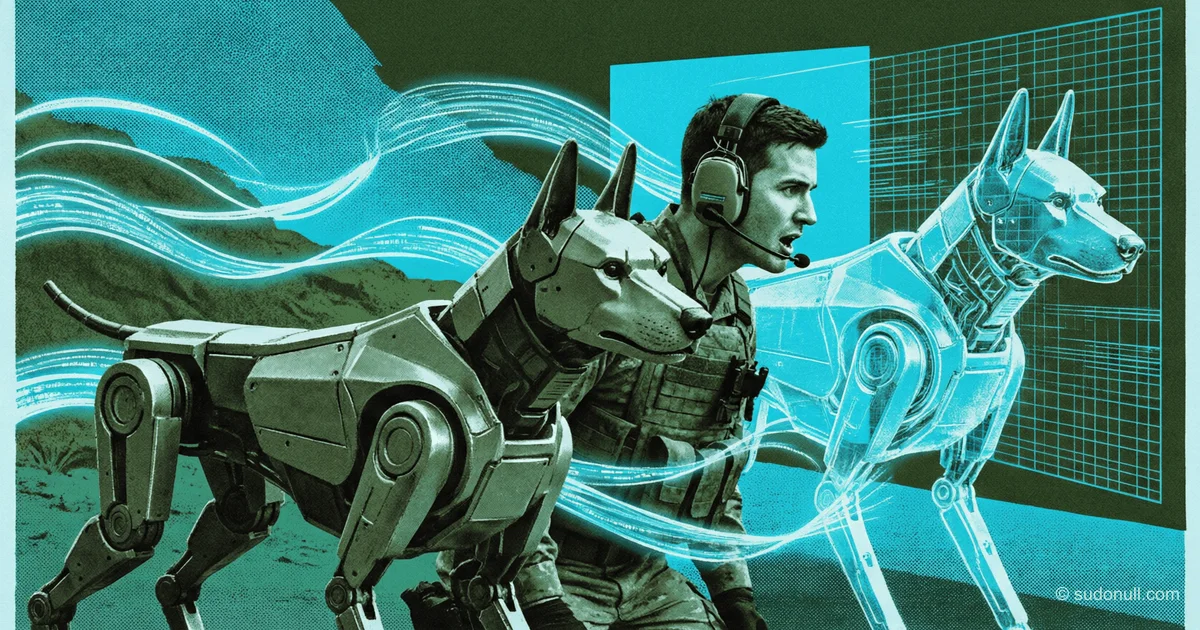
Hyundai Rotem develops physical AI for voice-controlled robots
Hyundai Rotem has won two government projects in South Korea to develop physical AI, including a system for voice and text control of multiple autonomous robots.
Analytical article: Voice control for robots. Why Hyundai Rotem's projects are not innovation but a desperate attempt to catch a departing train
Author: Independent analyst with insider perspective
Date: 2026-05-28
On May 26, 2026, Hyundai Rotem announced it had won two South Korean government tenders to develop "physical AI" systems. The first project involves controlling heterogeneous robots via voice and text commands. The second is a digital twin and modular platform for four-legged robots with detachable wheels.
It sounds like the future has arrived. But if you think Hyundai Rotem is making a technological leap, you're wrong. In reality, we are witnessing a classic story: a defense contractor that missed a paradigm shift is trying to catch up with competitors at taxpayer expense.
And the key question here is not even about technology, but why two essentially identical projects were awarded to different government customers.
[The essence]: what is really happening
The formal reason is the development of physical AI for defense and industrial applications. The real reason is Hyundai Rotem's fear of being left without orders in a new reality where robots replace soldiers.
Note the dates. In January 2026, Hyundai Rotem underwent a major reorganization, creating a separate "Robotics and Hydrogen" division. CEO Lee Yong-bae in his New Year's address spoke about "the need to ensure technological sovereignty." It sounds grand. But what lies behind these words?
Behind them is panic. Because competitors are already there.
Hanwha Aerospace showcases its Arionsmet and Grunt at exhibitions. LIG D&A, through its US subsidiary Ghost Robotics, is already supplying Vision60 robot dogs to US Air Force bases. And Hyundai Rotem? They have the HR-Sherpa (multipurpose unmanned platform) and prototypes of walking robots developed jointly with Rainbow Robotics. But none of these systems are yet deployed in significant numbers.
So they turn to the government. Two projects, two sources of funding. The Ministry of Trade, Industry and Energy handles "rapid commercialization." The Agency for Defense Development (ADD) handles "future technologies." Two government funding streams that can be opened simultaneously. Brilliant from a bureaucratic standpoint. But what does it say about the company's technological maturity? That it lacks its own R&D funds.
Timeline and context
- January 2026: Hyundai Rotem reorganization. Creation of robotics and hydrogen division. Reduction of departments from 37 to 35, centers from 15 to 14. This is "optimization" in corporate report language. In reality, an attempt to become more agile because the old structure wasn't working.
- Early May 2026: Signing of a memorandum with Anduril Industries, Palmer Luckey's American defense startup. This is an admission that their own technologies are insufficient.
- Mid-May 2026: Demonstration of HR-Sherpa and robot dogs at the BSDA 2026 exhibition in Romania. Showcasing reconnaissance, fire support, and even firefighting. A nice presentation, but note: no word about real contracts with the Romanian army.
- May 26, 2026: Announcement of winning two government projects.
What stands out? Between the demonstration in Romania and the announcement of government projects in Korea, there are 10 days. Coincidence? Or an attempt to create a buzz before officially announcing government support?
Who wins and who loses
Winners (obvious):
- South Korean Ministry of Defense. Gains control over the development of standards for combat robots without paying market prices. Two projects allow comparing approaches and selecting the best.
- Hyundai Rotem (short-term). Government funding guarantees money for 2-3 years. The company can report "strategic projects" to shareholders even without commercial sales.
Winners (less obvious):
- Anduril. Their memorandum with Hyundai Rotem now looks like a ticket to the Korean market. Anduril will gain access to swarm technology and sensors, while giving Hyundai Rotem what the Koreans lack: combat experience (Anduril supplies "sentry towers" to the US-Mexico border).
- Rainbow Robotics. The Korean robotics startup collaborating with Hyundai Rotem. For them, Hyundai's government projects mean stable orders for components.
Losers:
- Hanwha Aerospace. Direct competitor to Hyundai Rotem in defense. Hanwha also develops combat unmanned platforms but didn't receive government funding in this round. This hits their position.
- Small Korean robotics startups. The government allocated money to a large player, not a startup competition. Innovations will emerge inside Hyundai Rotem's bureaucratic machine, not in garages.
What the media isn't saying
First omission: the projects are about interfaces, not AI.
All the hype around "physical AI" hides a simple truth: the main goal of the first project is to develop software that allows a single operator to control different robots via voice commands. It's not about robot "intelligence." It's about a "control panel." Currently, operators input commands manually via remote devices. The goal is to replace buttons with voice. Useful? Yes. Revolutionary? No.
Chinese DJI drones have been controlled via tablet with minimal training for years. American startups like Shield AI make autopilots that require no operator at all. Voice control is a step forward from buttons, but a step back from full autonomy.
Second omission: the second project is about simulation, not robots.
The second ADD project includes developing a digital twin—a virtual environment for testing robots. This is smart. Instead of breaking expensive prototypes in the field, you can break them in a computer. But this means the robot itself doesn't exist yet. There's a concept: a four-legged platform with detachable wheels that can carry manipulators or explosive sensors. Sounds like Boston Dynamics Spot with wheels. By the way, Spot is already for sale.
Third, and most important omission: the Ukrainian context is a trigger, not a technology driver.
All Korean media write about Ukraine, where drones and robots are already capturing positions without humans. And it's true—in April 2026, Ukrainian forces successfully used only drones and ground unmanned vehicles to capture Russian positions.
But what they don't write: Ukrainian robots are cheap, disposable, often Chinese platforms modified in garages. Hyundai Rotem is building expensive, complex, military-grade systems. These are two different philosophies. The Koreans want to be like the US—with premium million-dollar robots. But the war in Ukraine shows that winners are those with a thousand $10,000 robots. Hyundai Rotem isn't late in technology. They're late in business model.
Forecast: next 30 days and 90 days
Next 30 days (by end of June 2026):
Expect news that Hyundai Rotem is hiring natural language processing (NLP) specialists. Voice control of robots is a task for linguists, not roboticists. Competition for such specialists in Korea is high—they are poached from Naver and Samsung.
Also, within a month, the budget for the two projects will be announced. Similar Korean government AI projects are typically valued at 5-10 billion won each (approximately $3.7-7.4 million). For Hyundai Rotem, with annual revenue of several trillion won, this is a drop in the bucket. But symbolically important.
Next 90 days (by end of August 2026):
Closer to August, expect a prototype demonstration of the control system—likely in the form of a video where an operator says "HR-Sherpa, move to point A" and the robot (already moving on a test range) obeys. It will look impressive. But the question behind the scenes remains: what if the operator says "destroy target" and the robot makes a mistake? Who is responsible? Ethical and legal questions about "killer robots" are raised by Korean media, but government projects currently sidestep them.
My forecast: by August, Anduril and Hyundai Rotem will announce their first joint product—likely a "sentry tower" for the Korean Demilitarized Zone, using Anduril's technology and Hyundai Rotem's manufacturing capabilities. This will be a politically significant deal.
But globally, Hyundai Rotem's project is a story of a traditional industrial giant trying to transform into a tech company at government expense. Will it succeed? Given their pace (projects span years, while competitors are already selling), odds are 50-50. But if it fails, Korea will be left without its own robotic army at a time when it needs one. And it will need one sooner than it seems.
— Editorial Team








No comments yet.